

Magic Mushroom Cultivation Checklist for Canadians
TL;DR:
- Growing magic mushrooms in Canada requires understanding legality, safety, and proper setup.
- PF Tek is beginner-friendly, while monotubs offer higher yields and contamination resistance.
- Proper harvesting, drying, and storage ensure potency and safety of the final product.
Growing magic mushrooms at home in Canada is more accessible than most people think, but the gap between a successful harvest and a contaminated, wasted grow comes down to preparation. Canadians face a unique set of considerations, from understanding the legal landscape around psilocybin mushroom spores to choosing the right method for their space, budget, and experience level. This checklist-driven guide walks you through every critical step, from selecting your strain and gear to harvesting and storing your final product, so you spend less time troubleshooting and more time getting results.
Table of Contents
- Essential criteria before you start: Safety, legality, and basics
- Complete cultivation checklist: Tools, substrates, and setup
- Cultivation methods compared: PF Tek vs. monotub systems
- Key steps for contamination prevention and maximizing yields
- Harvesting, drying, and storage: Final steps for quality mushrooms
- What most new growers get wrong—and how to really succeed
- Unlock more with quality products and expert resources
- Frequently asked questions
Key Takeaways
| Point | Details |
|---|---|
| Check local regulations | Confirm legality before starting any psilocybin mushroom cultivation project in Canada. |
| Prepare the right tools | Use sterilized supplies, proper equipment, and a clean space for contamination-free grows. |
| Choose the best method | PF Tek is great for first-timers; monotub systems offer more yield and less contamination risk. |
| Prevent contamination | Cleanliness and environmental control are critical for a successful harvest. |
| Harvest and store safely | Dry and store mushrooms properly to maintain potency and avoid mold. |
Essential criteria before you start: Safety, legality, and basics
With the context set, let’s break down what you need to know and check off before you even start your grow.
Before you buy a single jar or spore syringe, you need to get clear on what’s legally permissible in your province. In Canada, psilocybin itself is a Schedule III controlled substance under the Controlled Drugs and Substances Act. Spores, however, exist in a legal gray area because they contain no psilocybin until germination. Many Canadians purchase spores for “research and microscopy” purposes. The moment those spores germinate into mycelium, you’re entering regulated territory. Understanding where that line sits helps you make informed decisions about how you proceed and what risks you’re taking on. You should review safe cultivation practices before going further.
Personal safety is the second major criterion. Contamination is the most common hazard, and it’s not just about wasted substrate. Mold species like Trichoderma (a fast-growing green mold) and Cobweb mold can ruin an entire grow and, in some cases, cause respiratory issues if disturbed in an enclosed space. Setting up in a well-ventilated area, wearing gloves and a mask during sensitive work, and never inhaling near disturbed substrate protects both your health and your crops.
Here’s a quick pre-start checklist:
- Confirm your understanding of federal and provincial regulations around spore and mycelium cultivation
- Identify a suitable, cleanable space with stable temperature between 70 and 75°F (21 to 24°C)
- Source your spores from a reputable Canadian supplier
- Decide on your cultivation method before purchasing supplies (more on this in the next section)
- Purchase alcohol wipes, nitrile gloves, and a still air box or flow hood for clean transfers
Choosing the right strain matters more than most beginners realize. Golden Teacher, B+ (Be Positive), and Ecuadorian are popular beginner-friendly strains with reliable colonization speeds and solid yields. More aggressive strains like Penis Envy are higher in potency but slower to colonize and more demanding of precise conditions. The cultivation techniques guide covers strain selection in depth if you want to dig further.
Method at a glance: PF Tek uses small jars with brown rice flour and vermiculite (BRF/verm) substrate. It’s beginner-friendly, low-cost, and forgiving of minor errors. Monotub grows use larger tubs with bulk substrate like coco coir or manure, offering better contamination resistance because fast colonization outpaces contaminants before they take hold.
Pro Tip: Never start your first grow in a carpeted room or near an HVAC intake vent. These environments carry invisible spore loads that dramatically raise your contamination risk.
Complete cultivation checklist: Tools, substrates, and setup
Now that the criteria are clear, use this checklist to set yourself up right from the start.
Having the right gear before you begin saves you from mid-grow scrambles. Nothing disrupts a clean grow faster than opening a contaminated jar just to check, then realizing you needed a fresh transfer surface and have nothing sterile on hand.
Here’s your core equipment and substrate checklist in order of use:
- Pressure cooker (15 PSI minimum): Used to sterilize grain and substrate. A 23-quart model handles 6 to 8 quart jars at once.
- Wide-mouth mason jars (quart or half-pint): For PF Tek cakes or grain spawn.
- Spore syringe or agar culture: Your genetic starting point. Quality matters here.
- Brown rice flour and vermiculite: Core PF Tek substrate. Mix in a 2:1 ratio (verm to BRF) for best water retention.
- Bulk substrate materials (for monotub): Coco coir, field capacity hydrated, mixed with vermiculite at a 50/50 ratio as a standard, contamination-resistant base.
- Nitrile gloves and 70% isopropyl alcohol wipes: For every transfer and work session.
- Polyfill fiber or micropore tape: To create a filtered port in jar lids for gas exchange without contamination.
- Monotub or shoebox container (54-quart recommended): For the fruiting chamber.
- Hygrometer and thermometer: To monitor humidity and temperature in real time.
- A still air box (SAB) or laminar flow hood: For spore inoculations and transfers.
For substrates, your choice directly affects yield. According to dry yield data, PF Tek produces 3 to 7 grams dry per cake across 3 to 4 flushes, while a 54-quart monotub can yield 10 to 50 grams dry per flush. That’s a significant gap if you’re growing for consistent personal supply.
If you’re starting out and want to skip the pressure cooking step entirely, look into an all-in-one grow kit that arrives pre-sterilized. For growers scaling up to grain-based colonization, sterilized grain bags eliminate one of the most contamination-prone steps in the process.
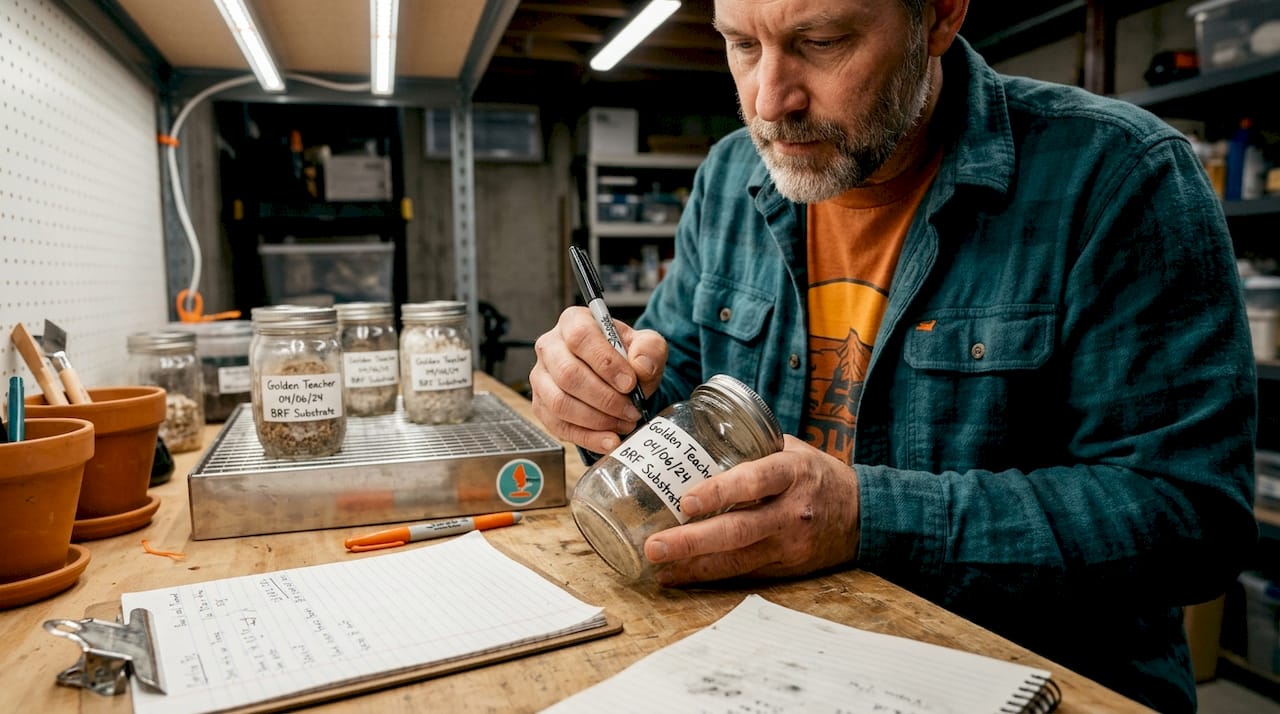
Pro Tip: Use a sharpie to label every jar with the strain name, inoculation date, and substrate type. When something goes wrong (and eventually it will), clear records tell you exactly where the failure happened.
Cultivation methods compared: PF Tek vs. monotub systems
With the tools and setup ready, let’s decide on the cultivation technique that matches your resources and risk profile.
The two most practical methods for Canadian home growers are PF Tek and the monotub system. Each has a distinct cost profile, yield ceiling, and learning curve. Understanding the tradeoffs at a practical level helps you invest in the right setup from the start.
| Feature | PF Tek | Monotub |
|---|---|---|
| Startup cost | Low ($30 to $60) | Moderate ($80 to $150) |
| Yield per flush | 3 to 7g dry per cake | 10 to 50g dry per flush |
| Contamination risk | Moderate to high | Lower (fast colonization) |
| Space required | Small (countertop) | Medium (54-qt tub) |
| Best for | Beginners | Experienced growers |
| Flushes possible | 3 to 4 | 2 to 4 |
| Labor intensity | Moderate | Lower after setup |
PF Tek strengths:
- No bulk substrate preparation required
- Inexpensive to start and easy to repeat
- Mistakes affect only one cake, not an entire tub
PF Tek weaknesses:
- Lower yield ceiling per grow cycle
- Higher contamination exposure during casing and fruiting
- Requires birthing cakes (removing colonized substrate from jars), which creates contamination windows
Monotub strengths:
- Higher yield per flush, with better contamination resistance because mycelium colonizes substrate faster than most contaminants can establish
- Less hands-on management during fruiting
- Scalable: you can run multiple tubs with minimal added labor
Monotub weaknesses:
- One contamination event can destroy an entire bulk tub
- Requires more substrate, grain spawn, and space
- Steeper learning curve on environmental control
You can explore detailed growing methods examples to see how each technique plays out in real grows.
Key steps for contamination prevention and maximizing yields
Once you’ve chosen your method, follow these contamination-prevention best practices for a rewarding harvest.
Contamination doesn’t announce itself until it’s usually too late to save the grow. Green, black, or pink patches in your substrate mean mold has taken hold. Prevention starts well before you see any fruiting pins.
Aseptic (sterile) technique essentials:
- Always spray your gloves and work surface with 70% isopropyl alcohol before any transfer
- Flame-sterilize your inoculation needle until it glows orange, then let it cool for 10 seconds before use
- Work in a still air box or in front of a flow hood to minimize ambient spore exposure
- Never breathe, sneeze, or cough over open jars or tubs
Environmental controls:
- Colonization phase: 75 to 80°F, no light needed, humidity not critical
- Fruiting phase: 72 to 76°F, 90 to 95% relative humidity, indirect light for 12 hours per day
- Fresh air exchange: fan for 30 to 60 seconds, twice daily during fruiting to prevent CO2 buildup
As the research confirms, monotub systems specifically benefit from bulk grain-to-substrate mixing because the rapid mycelium spread outpaces contaminant establishment. That principle carries into your safe consumption workflow as well, where purity of your harvest matters for predictable, safe outcomes.
| Contamination source | Symptoms | Solution |
|---|---|---|
| Trichoderma (green mold) | Green patches on substrate | Isolate and discard immediately |
| Cobweb mold | White, wispy, fast-spreading fuzz | Increase fresh air exchange |
| Bacterial blotch | Yellow/brown wet spots, foul smell | Discard, sterilize grow area |
| Cross-contamination | Random pinning failure | Improve SAB technique, re-sterilize tools |
Pro Tip: If you see green, black, or pink on your substrate, do not open the container indoors. Seal it in a bag outside before discarding to avoid spreading spores through your home.
Harvesting, drying, and storage: Final steps for quality mushrooms
Finally, after nurturing your mushrooms through the full lifecycle, the right harvesting and storage steps lock in all your effort.
Harvest timing directly impacts potency. Mushrooms are at peak psilocybin content just before or as the veil (the thin membrane between the cap and stem) begins to tear. Once that veil breaks and spores drop, potency begins to decline and the substrate is exposed to contamination risk.
Follow these steps for a clean, high-quality harvest:
- Watch for veil integrity: Harvest when the veil is still intact or just beginning to separate from the cap edges. Don’t wait for caps to fully open.
- Twist and pull (don’t cut): Grip the mushroom at the base and apply a gentle rotating pull. Cutting leaves a stump that can rot and contaminate the next flush.
- Clean the substrate surface: After each flush, remove any dead pins or leftover stem bases with a sterilized tool, then lightly mist the surface to encourage re-pinning.
- Dry immediately after harvest: Use a food dehydrator set to 95 to 100°F (35 to 38°C) for 4 to 8 hours, then finish with a desiccant (silica gel) in an airtight container for 24 hours to remove residual moisture.
- Store properly: Airtight glass jars with a desiccant packet, kept in a cool and dark location. Dried mushrooms stored this way hold potency for 12 to 24 months.
- Label everything: Strain name, flush number, harvest date, and dry weight.
According to documented yield data, monotub growers who optimize their substrate moisture and harvest timing consistently hit the upper end of the 10 to 50 gram dry yield range per flush. Those numbers come from methodical tracking, not luck. If you’re looking beyond cultivation toward prepared products, check out how mushroom edibles for wellness represent an alternative for consistent, measured intake.
Pro Tip: Record your dry weight for each flush in a simple notebook. After 3 or 4 grows, patterns emerge that tell you exactly where you’re losing yield, whether it’s substrate moisture, harvest timing, or CO2 levels during fruiting.
What most new growers get wrong—and how to really succeed
Here’s the honest reality: most new growers don’t fail because they miss a step on a checklist. They fail because they don’t pay attention closely enough to what’s actually happening in their grow.
The most common invisible mistake is impatience during colonization. Growers open jars or tubs too early to “check progress,” introducing contaminants and disrupting the fragile early mycelium network. Colonization looks slow for the first week and then accelerates. Resist the urge to intervene. That patience gap is where most first-time crops are lost.
The second overlooked error is treating the checklist as a formula rather than a framework. A checklist tells you what to do, but it can’t tell you that your grow space runs 5 degrees warmer on sunny afternoons, or that your tap water has a chloramine content that stresses mycelium. You need to observe, adjust, and build a feel for your specific environment. No two setups perform identically.
The monotub’s superior resistance to contamination comes from a specific dynamic: the mycelium grows faster than contaminants can establish. But that advantage disappears entirely if your grain-to-substrate ratio is off, your moisture content is too high, or you over-handle the tub during colonization. Understanding why a method works makes you a better troubleshooter than any checklist alone can.
Use your mushroom wellness checklist as a companion resource for thinking through safe outcomes from your harvest. The growers who improve fastest are the ones who treat every failed or subpar grow as data, not a defeat. Write down what you observed, what you changed, and what happened next. After three grows, you’ll have more practical knowledge than most online guides can provide.
Unlock more with quality products and expert resources
When you’re ready to go further, trusted gear and up-to-date resources make all the difference.
Whether you’re still in the research phase or wrapping up your first grow, Three Amigos offers a curated range of options that complement every stage of the journey. For those exploring the full spectrum of psilocybin experiences beyond cultivation, the selection of magic mushroom edibles provides a consistent, lab-quality alternative for Canadians prioritizing predictable dosing.
If you want to ground your growing practice in current science, the psilocybin science explained resource breaks down the research behind therapeutic applications in plain language. And if microdosing is part of your routine or something you’re curious about, the guide to microdosing psilocybin capsules gives you a science-backed approach to daily use that pairs naturally with a cultivator’s mindset. Three Amigos exists to support the full arc of your relationship with psilocybin, from the first grow to the most refined applications.
Frequently asked questions
What equipment do I need to start growing magic mushrooms in Canada?
You’ll need jars or tubs, sterilized substrate, spores, a pressure cooker, gloves, and a sterile workspace. For reference, documented grow data shows that monotub setups using proper equipment yield 10 to 50 grams dry per flush compared to 3 to 7 grams for basic PF Tek.
Which method is best for beginners: PF Tek or monotub?
PF Tek is the more forgiving starting point because mistakes affect only one cake at a time. Monotub offers higher yields and, because fast colonization outpaces contaminants, better contamination resistance once you understand environmental control.
How do I prevent contamination while growing mushrooms?
Sterilize all tools, work in a still air box, and control humidity and airflow throughout colonization and fruiting. Research confirms that bulk monotub methods resist contamination better than PF Tek due to faster substrate colonization.
What yields can I expect from each method?
According to yield comparisons, PF Tek produces 3 to 7 grams dry per cake across 3 to 4 flushes, while a 54-quart monotub typically delivers 10 to 50 grams dry per flush with optimized conditions.
What is the safest way to store dried magic mushrooms?
Store them in airtight glass jars with a silica gel desiccant packet, kept in a cool, dark location. This method preserves potency and prevents mold growth for up to 12 to 24 months after harvest.
Recommended
- Magic mushroom guide for Canadians: Safe, legal use
- Shop Magic Mushroom Grow Kits Online | 3 Amigos
- Psilocybin mushroom checklist: safe steps for Canadians
- Step-by-step mushroom safety guide for Canadians 2026

Thomas Wrona is a writer, designer, and wellness coach who believes that nature’s wisdom provides an antidote to the stress of modern life. As a former pro athlete, he’s all about staying in motion! When he’s not writing you’ll probably find Thomas outside.