
Mushroom fruiting conditions: guide to optimal yields
TL;DR:
- Mushrooms fruit in response to specific environmental cues like humidity, temperature, and light.
- Maintaining optimal humidity (85-95%), temperature (20-24°C), and fresh air exchange is essential.
- Observing your setup and adjusting conditions accordingly leads to consistent, healthy harvests.
If your magic mushroom grows keep stalling out or producing thin, underwhelming flushes, the problem is almost never your spores. Most Canadian growers hit a wall because the environmental signals that actually trigger fruiting are misunderstood or ignored entirely. Mushrooms don’t fruit randomly. They respond to very specific cues, and when those cues are missing, the mycelium simply waits. This guide breaks down every major fruiting variable, from humidity and temperature to substrate and strain-specific quirks, so you can stop guessing and start pulling consistent, healthy harvests.
Table of Contents
- Understanding the mushroom life cycle and fruiting triggers
- Key environmental factors: humidity, temperature, and fresh air
- Light and substrate: the often-overlooked factors
- Strain-specific needs: adjusting for popular Canadian psilocybin strains
- Troubleshooting and optimizing fruiting yields
- Why most guides miss the mark on real-world fruiting success
- Grow smarter with trusted Canadian mushroom resources
- Frequently asked questions
Key Takeaways
| Point | Details |
|---|---|
| Fruiting needs precision | Accurate temperature, humidity, and air exchange are vital for magic mushroom crops. |
| Substrate and light matter | Right substrate and indirect light can boost both yield and potency. |
| Strain differences are real | Every psilocybin strain may need small but important tweaks for the best results. |
| Troubleshoot early | Monitor and adjust quickly to avoid small issues becoming large crop failures. |
Understanding the mushroom life cycle and fruiting triggers
Before you can optimize anything, you need to understand what you’re actually working with. Magic mushrooms don’t just appear. They follow a predictable sequence, and each stage has its own requirements.
Here’s how the full life cycle unfolds:
- Spore germination: Spores land on a suitable substrate and begin to germinate, sending out thin threads called hyphae.
- Mycelium colonization: Hyphae spread and merge into a dense white network called mycelium. This is the vegetative stage, where the organism is feeding and growing.
- Primordia formation (pinning): Under the right environmental signals, the mycelium begins forming tiny pin-like structures. These are the earliest fruiting bodies.
- Fruiting body development: Pins mature into full mushrooms, caps expand, and the organism prepares to release spores.
- Harvest and flushing: After harvest, the substrate can produce multiple rounds of mushrooms, called flushes, before it’s exhausted.
Pinning is the critical transition point. It’s the moment the mycelium shifts from vegetative growth to reproduction, and it’s entirely driven by environmental signals. Mushroom fruiting is a response to specific cues including humidity, temperature, and light. Without those cues, colonized substrate can sit dormant for weeks.
For Psilocybe cubensis, the most commonly grown psilocybin species in Canada, the primary triggers are a slight temperature drop, increased fresh air exchange, high relative humidity, and exposure to indirect light. These signals mimic the transition from underground mycelium growth to above-ground fruiting in a natural forest environment.
“The mycelium is always ready. Your job is to give it a reason to fruit.”
For more background on mushroom cultivation in Canada, it helps to understand how local climate and seasonal patterns can influence your indoor setup, especially if you’re growing in a basement or garage where ambient temperature shifts throughout the year.
Pro Tip: Patience during colonization is everything. Rushing to fruiting conditions before the substrate is fully colonized leads to poor pin sets and weak flushes. Wait until the surface is at least 95% white before initiating fruiting.
With this context in mind, let’s dive into the specific conditions that kick-start mushroom fruiting.
Key environmental factors: humidity, temperature, and fresh air
Now that you know the triggers, mastering these three factors is your first step to predictable harvests.
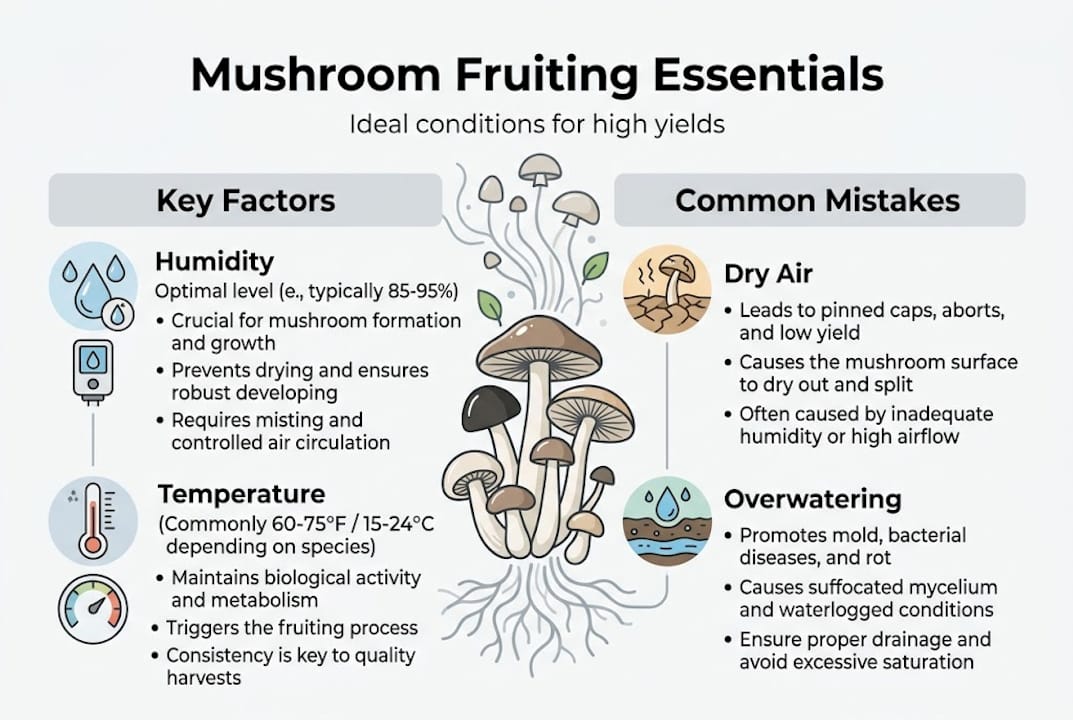
These three variables work together. Getting one right while neglecting the others will still produce disappointing results. Here’s the baseline you’re aiming for:
| Factor | Optimal range | Common mistake |
|---|---|---|
| Relative humidity | 85-95% | Too low causes dry, cracked caps |
| Temperature | 20-24°C | Too high accelerates contamination |
| Fresh air exchange | 3-6 times daily | Too little causes leggy, pale stems |
Optimal fruiting requires 85-95% humidity, temperatures between 20-24°C, and consistent fresh air exchange. In Canadian homes, especially during winter, indoor air tends to be very dry and cold near exterior walls. A small ultrasonic humidifier with a hygrometer is a practical, affordable solution for maintaining humidity inside a grow tent or monotub.
Signs that your environment is off:
- Fuzzy, elongated stems: Classic sign of too much CO2 and not enough fresh air
- Slow or absent pinning: Often points to humidity being too low or temperature being too cold
- Waterlogged substrate surface: Excess misting or poor drainage, which invites contamination
- Yellow or brown discoloration on caps: Usually heat stress or metabolite buildup from stale air
- Aborts (pins that die before maturing): Typically caused by inconsistent humidity swings
For guidance on safe psilocybin cultivation practices, understanding these environmental baselines is the foundation of everything else you’ll build on.
Pro Tip: Open your bins or grow tents at least 3 times daily, fanning gently with the lid to exchange stale, CO2-heavy air with fresh air. This simple habit alone can dramatically improve pin density.
Light and substrate: the often-overlooked factors
Beyond air and moisture, the role of substrate and light often flies under the radar.
Many growers assume mushrooms need darkness to fruit, like they’re growing in a cave. That’s not accurate. Mild indirect light cues mushroom fruiting, while substrate quality directly impacts yield and potency. Aim for 12-16 hours of indirect, ambient light per day. A simple LED room light or a north-facing window works well. Direct sunlight and heat lamps are too intense and will dry out your substrate.
Substrate choice is equally important. Here’s how the most common options compare:
| Substrate | Colonization speed | Contamination risk | Yield potential |
|---|---|---|---|
| Brown rice flour (BRF) | Moderate | Low | Moderate |
| Rye grain | Fast | Higher | High |
| Coco coir + vermiculite | Slow | Very low | Moderate |
| Pasteurized straw | Fast | Moderate | High |
Substrate dos and don’ts for Canadian growers:
- Do sterilize grain-based substrates at 15 PSI for 90 minutes to eliminate competing organisms
- Do use coco coir as a bulk substrate layer for its natural contamination resistance
- Don’t use garden soil or unsterilized organic material, which introduces mold and bacteria
- Don’t over-wet your substrate. It should feel like a wrung-out sponge, not soggy
- Do case your substrate with a thin layer of coco coir and vermiculite to retain surface moisture without waterlogging
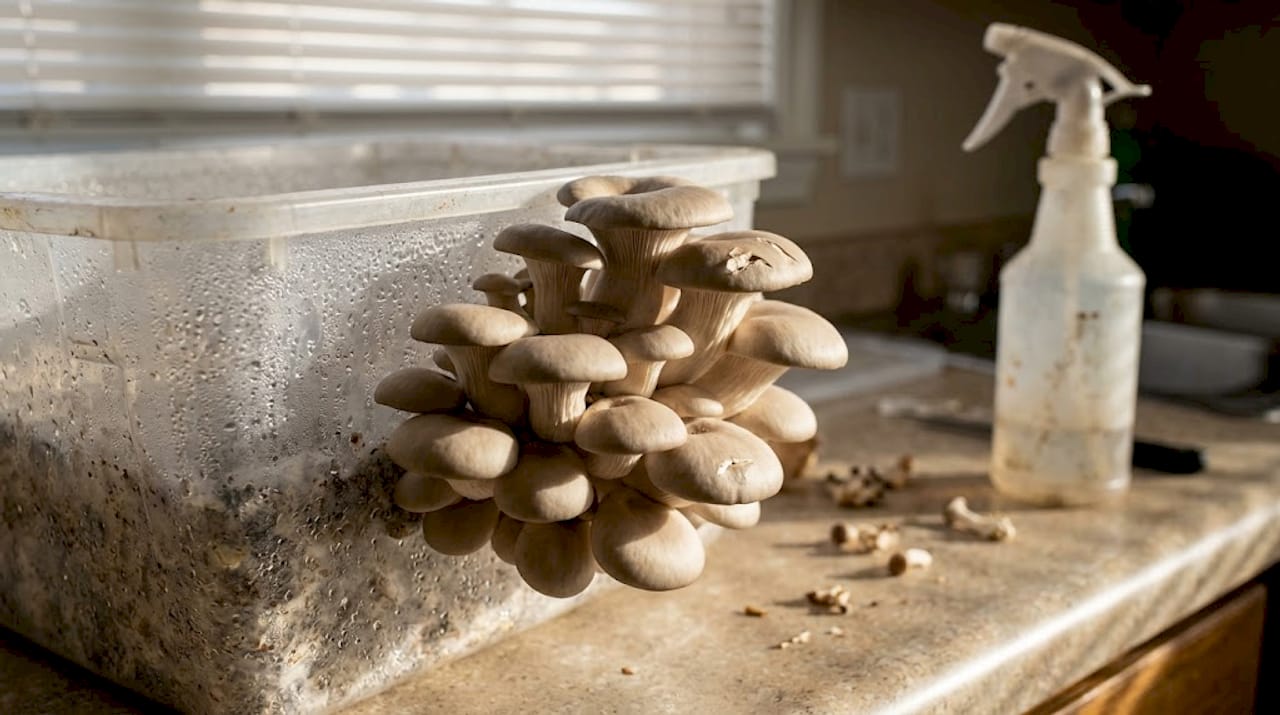
Poor substrate shows up in your harvest as small, dense pins that abort early, or caps that are thin and watery rather than firm and meaty. Exploring the wellness benefits of mushrooms starts with a quality grow, and substrate is where that quality is built from the ground up.
Strain-specific needs: adjusting for popular Canadian psilocybin strains
Once your basic setup is dialed in, knowing your strain is the difference between good and great results.
Not all Psilocybe cubensis strains fruit identically. Popular strains like Golden Teacher, Penis Envy, and B+ have unique optimal fruiting temperature and humidity requirements. These differences are subtle but meaningful, especially when you’re trying to maximize flush size and potency.
| Strain | Optimal temp (°C) | Optimal humidity | Pin set speed | Flush cycle |
|---|---|---|---|---|
| Golden Teacher | 22-24 | 90-95% | Moderate | 10-14 days |
| B+ | 21-24 | 88-93% | Fast | 8-12 days |
| Penis Envy | 21-23 | 90-95% | Slow | 14-21 days |
| Melmac | 21-23 | 90-95% | Slow | 14-20 days |
Strain-specific tweaks that make a real difference:
- Golden Teacher: Forgiving and fast. Great for beginners. Responds well to standard fruiting conditions with minimal fuss.
- B+: Thrives with slightly more aggressive fanning and benefits from a cold shock (dropping temperature to 18°C for 12 hours) to trigger a strong first pin set.
- Penis Envy: Needs patience. Slower colonization and pinning are normal. Resist the urge to change conditions too early.
- Melmac: A Penis Envy variant with similarly slow fruiting. Read more about Melmac strain effects to understand what makes this strain worth the extra wait.
Strain variance also affects how many flushes you’ll get. Golden Teacher and B+ typically produce 3-4 strong flushes, while Penis Envy and Melmac may give fewer but denser, more potent harvests.
Troubleshooting and optimizing fruiting yields
Even optimal setups can encounter hiccups. Here’s how to course-correct with confidence.
The five most common fruiting problems and how to fix them:
- Slow pinning: Check humidity first. If it’s above 85%, try a cold shock by reducing temperature to 18-19°C for 12-24 hours. Also increase fanning frequency.
- Contamination (green, black, or pink patches): Remove affected substrate immediately. Improve sterilization on your next run and reduce surface moisture.
- Stunted growth: Usually a CO2 problem. Increase fresh air exchange and check that your grow space isn’t sealed too tightly.
- Watery, thin caps: Often caused by excess surface moisture or harvesting too late. Harvest just before the veil under the cap tears.
- Sparse flushes after the first: Rehydrate your substrate by soaking it in cold water for 12-24 hours between flushes. This is called dunking, and it restores moisture lost during the previous flush.
Consistent monitoring and incremental adjustments to the environment are the real key to high-quality harvests. Chasing dramatic fixes usually does more harm than good.
Pro Tip: Keep a daily grow log. Note temperature, humidity, fanning frequency, and any visual changes. Patterns become obvious within a week, and you’ll catch problems before they become failures.
For those integrating cultivation into a broader wellness practice, the safe mushroom consumption workflow is a valuable companion resource once your harvests are consistent.
Why most guides miss the mark on real-world fruiting success
Having mastered troubleshooting, here’s the real lesson most cultivation resources skip entirely.
Almost every guide online treats mushroom cultivation like a chemistry exam. Get the humidity to exactly 92%. Hit 23°C on the nose. Follow the recipe perfectly. But experienced Canadian growers will tell you something different: the growers who get consistent results aren’t the ones who achieve theoretical perfection. They’re the ones who observe closely and adjust quickly.
Your basement in January is not the same environment as your spare room in July. A grow tent near a heating vent behaves differently than one in a cool corner. The growers who struggle most are often the ones rigidly following a guide written for someone else’s environment.
The real skill is building a feel for your specific setup. That comes from keeping notes, paying attention to how your mycelium responds, and making small, confident tweaks rather than overhauling everything at once. Check out advanced Canadian cultivation tips to keep building on that foundation. Flexibility, not perfection, is what produces repeatable harvests.
Grow smarter with trusted Canadian mushroom resources
If you’re ready to level up your cultivation or use, here are resources you can trust.
At Three Amigos, we back everything we offer with expert-reviewed content and quality-tested products designed for the Canadian market. Whether you’re dialing in your first fruiting chamber or looking to deepen your understanding of psilocybin science, we have resources built specifically for where you are in the journey.
Explore our full range of microdosing capsules for those who prefer a consistent, measured approach. Dig into the psilocybin science benefits to understand what your harvests are actually producing. And if you’re curious about the therapeutic side of what you’re growing, our therapeutic mushroom resources offer a grounded, research-backed perspective on safe and intentional use.
Frequently asked questions
What are the ideal humidity and temperature levels for fruiting magic mushrooms in Canada?
Fruiting needs 85-95% humidity and temperatures between 20-24°C. In Canadian winters, a small humidifier and a thermometer inside your grow space are essential tools.
How much light do magic mushrooms need for fruiting?
Mushrooms need mild, indirect light for 12-16 hours per day to cue healthy fruiting. Total darkness is a myth and can actually slow down or prevent a strong pin set.
What is the most common mistake Canadian growers make with fruiting conditions?
Over-watering and poor air exchange are the top errors. Both lead to contamination or stalled growth, and air exchange and moisture control are the two variables most often neglected by beginners.
Can different mushroom strains require different fruiting setups?
Yes. Strains like Golden Teacher and Penis Envy have unique temperature and humidity preferences, and Penis Envy in particular requires more patience with slower pin set times than most beginner-friendly strains.
Recommended
- How to Make Magic Mushroom Chocolate: A Guide for Beginners
- Magic mushroom cultivation guide: techniques and tips for Canada
- Mushroom Harm Reduction Workflow for Safe Use
- Step-by-step mushroom safety guide for Canadians 2026

Thomas Wrona is a writer, designer, and wellness coach who believes that nature’s wisdom provides an antidote to the stress of modern life. As a former pro athlete, he’s all about staying in motion! When he’s not writing you’ll probably find Thomas outside.