
How to Prepare for Your First Psilocybin Trip Safely
TL;DR:
- Psilocybin is illegal for recreational use in Canada but can be accessed legally for medical or research purposes.
- The key to a positive trip is setting clear intentions and creating a safe, comfortable environment.
- Proper preparation, including dosage, environment, and post-experience integration, is essential for safety and benefit.
That mix of excitement and nerves you’re feeling right now is completely normal. Thousands of Canadians are curious about psilocybin, and many are taking their first steps toward a psychedelic experience without knowing where to start. The stakes feel high because they are. A poorly prepared trip can spiral into anxiety, confusion, or worse, while a well-planned one can be genuinely life-changing in the best possible way. This guide covers everything you need to know before you sit down, including the legal reality in Canada, how to prepare your mind and space, the right dosage approach, and what to actually expect when the mushrooms kick in.
Table of Contents
- Understanding psilocybin and the law in Canada
- Setting your intention and mindset
- Preparing your environment: set and setting essentials
- Dosing, safety, and the psilocybin experience
- What most guides miss about preparing for a psilocybin trip
- Next steps: Explore psilocybin safely and confidently
- Frequently asked questions
Key Takeaways
| Point | Details |
|---|---|
| Know Canadian law | Psilocybin is only legal with specific medical exemptions or through Health Canada’s programs. |
| Prepare your mindset | A clear intention and open attitude help foster a safer, more meaningful experience. |
| Set and setting matter | A supportive environment with a trusted sitter can make all the difference. |
| Start with a low dose | Begin with a small amount to gauge your sensitivity and reduce risks. |
| Integration is essential | Reflect and talk through your experience afterwards to maximize personal growth. |
Understanding psilocybin and the law in Canada
Before anything else, you need to understand what psilocybin actually is and where you stand legally. Psilocybin is the naturally occurring psychedelic compound found in certain species of mushrooms, commonly called magic mushrooms or shrooms. Once consumed, your body converts it to psilocin, which binds to serotonin receptors in your brain and produces profound changes in perception, emotion, thought patterns, and sometimes visual or auditory experiences.
The effects are not random. Psilocybin temporarily disrupts your brain’s default mode network, which is the mental system responsible for your sense of self and habitual thought loops. This is why many users report feeling unusually connected, emotionally open, or deeply reflective during a trip.
Now, the legal part. Canada does not freely permit recreational use of psilocybin. The compound is classified as a controlled substance under the Controlled Drugs and Substances Act. As Health Canada confirms, psilocybin is only legal under two narrow pathways: the Special Access Program (SAP), which allows patients with serious or life-threatening conditions to access the substance under medical supervision, and Section 56 exemptions, which have been granted to specific researchers, therapists in training, and palliative care patients. Recreational use still carries real legal risks, including possession charges.
That said, understanding the Psilocybin legality in Canada is not about scaring you off. It is about helping you make informed decisions. Many Canadians are exploring psilocybin in gray areas, and harm reduction starts with knowing exactly where the law stands.
For those pursuing therapeutic access, there is a structured safe, legal intake process that can make the experience both safer and more supported. Below is a quick comparison of pathways:
| Pathway | Who qualifies | Legal status | Oversight |
|---|---|---|---|
| Special Access Program (SAP) | Patients with serious illness | Legal | Health Canada and physician |
| Section 56 exemption | Researchers, palliative patients | Legal | Federally regulated |
| Recreational use | General public | Illegal | None |
| Ceremonial or supervised use | Varies by context | Gray area | No federal framework |
The evolving legal status of mushrooms means this landscape is changing quickly. Staying informed protects you.
“Psilocybin gives people a window into themselves they rarely access in daily life. But it works best when approached with respect, intention, and a clear understanding of both the benefits and the risks.”
Setting your intention and mindset
Once you understand the legal context, the next step is internal. The single biggest predictor of a positive psilocybin experience is not the dose or the location. It is your mental state going into it. Psychedelic researchers call this “set,” which refers to your mindset, emotional state, expectations, and intentions.
Intention setting is not mystical, it is practical. Before your trip, spend real time asking yourself what you want from this experience. Common intentions include:
- Emotional healing: Processing grief, trauma, or chronic anxiety
- Creative insight: Breaking through creative blocks or gaining new perspectives on work
- Self-exploration: Understanding personal patterns, relationships, or life direction
- Spiritual curiosity: Experiencing a sense of connection, awe, or meaning
- Simple curiosity: Wanting to understand what the experience is actually like
There is no wrong intention, but vague or flippant ones tend to lead to more disorienting trips. Write your intention down. Be specific. If you want to work through a difficult relationship, say that. If you want to feel joy and creativity, write that down too. Having a clear anchor helps you return to purpose if things get intense.

One of the most important concepts in mental health benefits of psilocybin research is emotional non-resistance. Psilocybin tends to surface whatever you have been suppressing. If you fight it, the experience amplifies the discomfort. If you lean into it with curiosity instead of fear, it often resolves much faster. Harm reduction guidance consistently emphasizes using a “talk through, not down” approach during difficult moments and surrendering to the experience rather than trying to control it.
Common mindset mistakes first-timers make:
- Taking mushrooms when already anxious or emotionally destabilized
- Setting an intention of “escaping” rather than exploring
- Not telling anyone they trust about the experience beforehand
- Consuming psilocybin without clearing their schedule or obligations
- Underestimating the emotional depth of even a moderate dose
Pro Tip: Two to three days before your trip, reduce alcohol, limit social media, and get extra sleep. Your nervous system will be calmer and more receptive, which sets you up for a smoother, more insightful experience.
Discussing your expectations with someone you trust, even if they are not joining you, adds an important layer of grounding. Knowing someone is available to check in can reduce baseline anxiety significantly.
Preparing your environment: set and setting essentials
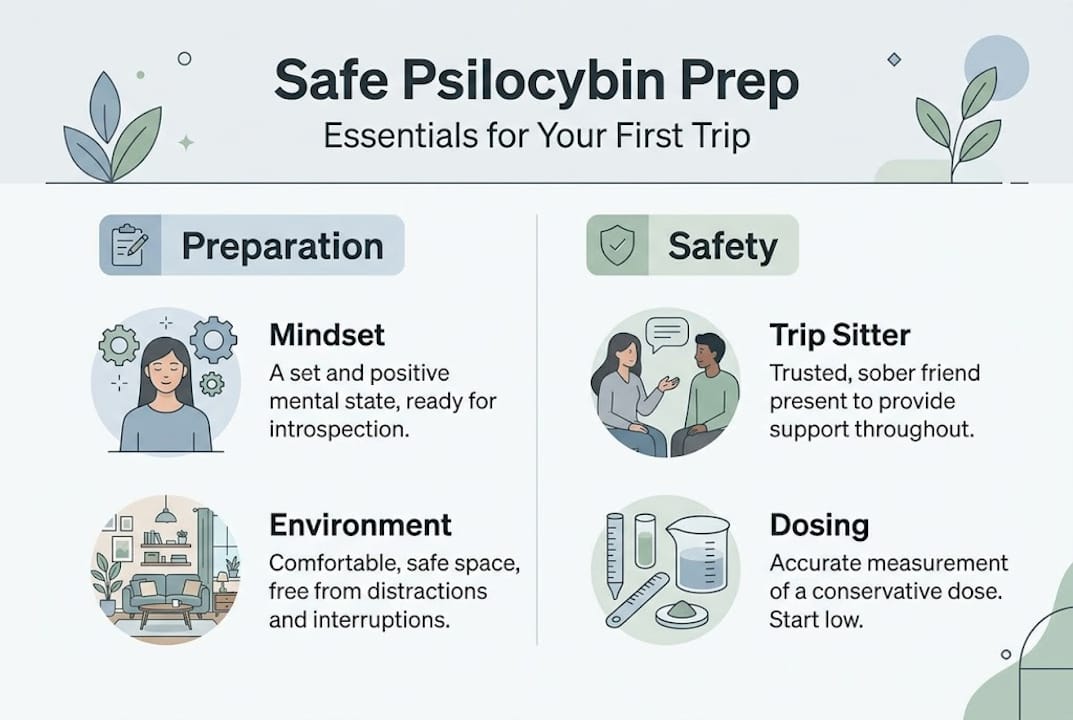
“Set and setting” is the foundational framework of psychedelic safety. Dr. Timothy Leary first coined the term, but modern researchers and therapists continue to validate its importance. Set refers to your internal state, which you covered in the last section. Setting is everything external: where you are, who you are with, what sounds and objects surround you, and how comfortable your body feels.
Getting your setting right is not optional. A chaotic, unpredictable, or socially pressured environment dramatically increases the risk of a difficult experience. Follow the mushroom consumption safety workflow to systematically check each element before your trip day.
Step-by-step: preparing your space
- Choose a private, familiar location where you will not be interrupted for 8 hours minimum
- Clean and tidy the space in advance, since visual clutter can feel overwhelming during a trip
- Remove anything that carries stressful associations, like work emails or difficult reminders
- Set up comfortable seating and a place to lie down with blankets and pillows
- Prepare a music playlist in advance, ideally instrumental or ambient without lyrics
- Have water, light snacks like fruit, and a bucket nearby in case of nausea
- Charge your phone but silence notifications and put it out of easy reach
- Place meaningful objects or art in the space if they feel comforting to you
Here is a comparison of environments to help you evaluate your space:
| Feature | Ideal setting | Risky setting |
|---|---|---|
| Location | Private home, familiar space | Festival, public area, unfamiliar place |
| Company | Sober trip sitter or trusted friend | Strangers or large group |
| Noise | Soft music, quiet | Loud music, unpredictable sounds |
| Responsibilities | Cleared schedule | Work or family obligations nearby |
| Substances | Psilocybin only | Alcohol or other drugs mixed in |
Your psilocybin safety protocols should also include arranging a trip sitter. A trip sitter is a sober person, ideally someone who has some familiarity with psychedelics, who stays with you throughout the experience. Their role is not to guide or lead your experience but to provide calm reassurance, handle any practical needs, and step in gently if you become distressed. The harm reduction principle of “talk through, not down” is key here. A good trip sitter does not try to talk you out of what you are experiencing. They validate it and help you move through it.
Pro Tip: Give your trip sitter a written note beforehand explaining your intention and any personal triggers. If you become overwhelmed, this gives them the context to support you more effectively without you needing to explain anything mid-trip.
Dosing, safety, and the psilocybin experience
Now for one of the most practical questions every first-timer asks: how much do I actually take? The honest answer is that mushroom potency varies, individual biology varies, and what feels moderate to one person can feel overwhelming to another. That said, evidence-based guidance points toward a clear starting point.
For a first experience, most harm reduction experts recommend between 1 and 2 grams of dried psilocybin mushrooms. One gram or less produces very mild, almost threshold effects that help you understand how your body responds. Two grams typically produces a clear psychedelic experience without being overwhelming. Anything above 3.5 grams is considered a high or “heroic” dose and is not appropriate for beginners under any circumstances.
First-time dosage overview:
- Microdose (0.05 to 0.3g): Subtle, sub-perceptual. No full trip, used for safe psilocybin dosing and functional enhancement
- Low dose (0.5 to 1g): Mild perceptual changes, mood lift, light visuals
- Moderate dose (1 to 2.5g): Clear psychedelic effects, emotional opening, recommended for first-timers
- High dose (3.5g and above): Intense, ego-dissolving, not for beginners
Do not mix psilocybin with alcohol, cannabis, SSRIs, MAOIs, or any other substance without thorough research. Combining substances can unpredictably amplify or suppress the experience. SSRIs in particular can reduce psilocybin’s effects, but stopping medication suddenly to try mushrooms carries serious mental health risks. Always consult a healthcare provider if you take any prescription medication.
The timeline of a typical first experience looks like this: onset begins within 30 to 60 minutes, effects peak around the 2 to 3 hour mark, and the experience gradually tapers off over the next 2 to 3 hours. Most trips last between 4 and 6 hours total. Budget the full day, including wind-down time.
“The legal risks of recreational psilocybin use in Canada mean that anyone consuming outside clinical settings should take extra responsibility for their physical and emotional safety.”
Physical safety matters too. Psilocybin is not physically toxic at normal doses, but nausea is common in the first hour, especially on an empty or recently eaten stomach. Eating lightly 3 to 4 hours before consumption reduces this. You will not feel like eating during the trip, and that is fine. Stay hydrated. Review safe usage tips to understand emergency steps if the experience becomes unmanageable, including lying down in a quiet, dark room, focusing on your breath, and calling a trusted person if you feel genuinely unsafe.
What most guides miss about preparing for a psilocybin trip
Every checklist guide covers set, setting, and dosage. Far fewer talk honestly about what happens after. Integration, meaning the process of making sense of what you experienced and weaving it into your daily life, is where the real transformation happens.
A powerful psilocybin experience without integration is like a profound dream you never think about again. It fades. The insights dissolve. You return to the same patterns. But when you sit with the experience, journal about it, talk to a therapist or a trusted friend, or connect with a community of people on similar paths, the experience starts to actually shift how you live.
Most first-timers underestimate how emotionally active the days following a trip can be. You might feel unusually raw, reflective, or emotionally open. That window is valuable. Use it intentionally. The step-by-step experience guide at Three Amigos covers integration in detail, including journaling prompts and frameworks for understanding what came up during your journey.
Preparation is not a checklist you complete once. It is a mindset you carry from the moment you decide to do this, through the experience itself, and into the weeks that follow. The people who benefit most from psilocybin are the ones who treat the entire arc, before, during, and after, as equally important.
Next steps: Explore psilocybin safely and confidently
If this guide has sparked something in you, the next step is building on it with the right resources and products. At Three Amigos, we specialize in supporting Canadians who are approaching psilocybin thoughtfully and responsibly.
For those just starting out, our microdosing mushroom capsules are one of the best ways to gently explore how psilocybin affects your body and mind before committing to a full experience. If you want to go deeper into the research, our guide on psilocybin science explained walks you through what the current evidence actually says. And when you are ready to plan your first full journey, the psilocybin trip guide gives you a detailed, step-by-step map of exactly what to expect. Quality, education, and your safety come first, always.
Frequently asked questions
Is it legal to use psilocybin mushrooms for personal use in Canada?
No, as confirmed by Health Canada, psilocybin is illegal for personal or recreational use in Canada except through the Special Access Program or specific Section 56 exemptions for serious conditions.
How much psilocybin should a first-time user take?
Start with a low to moderate dose between 1 and 2 grams of dried mushrooms, avoid mixing with any other substances, and always arrange a trusted sitter before your experience begins.
How long does a psilocybin trip last?
A typical psilocybin experience lasts 4 to 6 hours total, with onset occurring within 30 to 60 minutes of consumption and effects peaking around the 2 to 3 hour mark.
What is the role of a trip sitter?
A trip sitter is a sober, trusted person who stays present throughout your experience to provide calm reassurance, handle any practical needs, and offer grounded support if things get difficult, without trying to redirect or control what you are feeling.
How can I reduce anxiety or a “bad trip” during the experience?
Practice surrendering to the experience rather than fighting it, stay in your planned safe setting, use your breath to ground yourself, and lean on your trip sitter to help you talk through, not out of, what you are experiencing.
Recommended
- Psilocybin Experience Step by Step: A Complete Guide
- How to Dose Psilocybin Safely for Best Results
- Psilocybin Safety Workflow: Step-by-Step Guide for Canada
- Psilocybin Safety Protocols: Protecting Wellness in Canada

Thomas Wrona is a writer, designer, and wellness coach who believes that nature’s wisdom provides an antidote to the stress of modern life. As a former pro athlete, he’s all about staying in motion! When he’s not writing you’ll probably find Thomas outside.