

Why use psychedelic blends? Evidence, safety, and insights
TL;DR:
- Choosing a psychedelic blend is less important than set, setting, and proper protocol in achieving meaningful experiences. Research indicates that mindset and environment influence outcomes far more than the specific mushroom mix or compound used. Ensuring professional guidance and safe practices remain essential for responsible and effective use in Canada.
Many Canadians exploring psilocybin for the first time believe the secret to a powerful, healing experience lies entirely in which blend or strain they choose. Pick the right mushroom mix, the thinking goes, and transformative results will follow automatically. But a growing body of evidence challenges that assumption directly. The compound blend is one piece of a larger puzzle, and the research consistently shows that mindset, environment, and structured protocol often account for far more of the outcome than the chemistry of what you take. Understanding why requires looking at both the emerging science and the practical realities of responsible psychedelic use in Canada.
Table of Contents
- What are psychedelic blends and how are they used?
- What does the science say about blends versus single compounds?
- Why context, mindset, and protocol matter as much as the blend
- Safety, oversight, and how to access blends legally in Canada
- A clinical perspective: Blends are not a shortcut—context is the multiplier
- Exploring blends safely: Trusted resources and next steps
- Frequently asked questions
Key Takeaways
| Point | Details |
|---|---|
| Blend effects are complex | Blends may influence multiple brain targets, but clear human advantages need more proof. |
| Mindset and context rule | Outcomes depend more on your preparation, mindset, and environment than the specific blend. |
| Safety needs oversight | Medical screening and legal access routes are essential when considering blends. |
| Protocols beat random mixing | Following structured, supported protocols provides more reliable results than DIY blends. |
What are psychedelic blends and how are they used?
The term “psychedelic blend” gets thrown around loosely, and that looseness causes confusion. At its most basic, a psychedelic blend refers to a preparation that combines more than one mushroom strain, or pairs mushroom-derived compounds with other botanicals or functional ingredients. Think of a capsule that mixes two Psilocybe cubensis varieties with lion’s mane mushroom, or a dried blend formulated with adaptogens for a gentler experience. The blend is distinguished by the intent to create a multi-ingredient effect rather than relying on one isolated compound.
People seek out blends for several overlapping reasons:
- Broadened effects profile: Some users report that single-strain experiences feel one-dimensional, and blends may offer a wider range of sensory or emotional textures.
- Perceived synergy: The hope that two or more compounds interact to produce something greater than the sum of their parts.
- Personal growth and creativity: Many Canadians use blends at lower doses specifically for productivity, artistic work, and emotional insight rather than full ceremonial experiences.
- Harm reduction: Some blends are designed to soften intensity, using complementary botanicals to ease nausea or anxiety.
It is important to separate a consumer blend from the standardized preparations used in clinical trials. Researchers study purified psilocybin at precise, verified doses. A commercially available blend has variable concentrations, and that variability matters enormously for predictability and safety.
The mechanistic rationale behind blends borrows from a concept called the entourage effect. You can read a detailed breakdown of understanding the entourage effect on how multiple mushroom-derived compounds may interact with different brain receptors simultaneously. A 2026 Scientific Reports study confirmed that blends and whole-extract approaches include the notion that extra mushroom-derived compounds may offer multi-target effects, suggesting synergy is biologically plausible, even if the human evidence is still catching up.
Pro Tip: More ingredients in a blend does not automatically mean a safer or stronger experience. Complexity can make dosing less predictable, not more powerful. Start with well-characterized products before experimenting with complex formulations.
What does the science say about blends versus single compounds?
The scientific picture is genuinely nuanced, and anyone selling you certainty in either direction is oversimplifying. Here is what the current evidence actually shows.

A 2026 Scientific Reports study provided computational and molecular evidence supporting enhanced efficacy of whole mushroom extracts through multi-target effects. In plain terms: the chemistry makes a theoretical case for blends. Receptors like HTR2A and enzymes like MAOA may be engaged differently when multiple compounds are present versus a single molecule alone. That is meaningful preliminary data. But the study is careful to note that direct human clinical evidence is still emerging, meaning the laboratory logic has not yet been confirmed at scale in trials with real people.
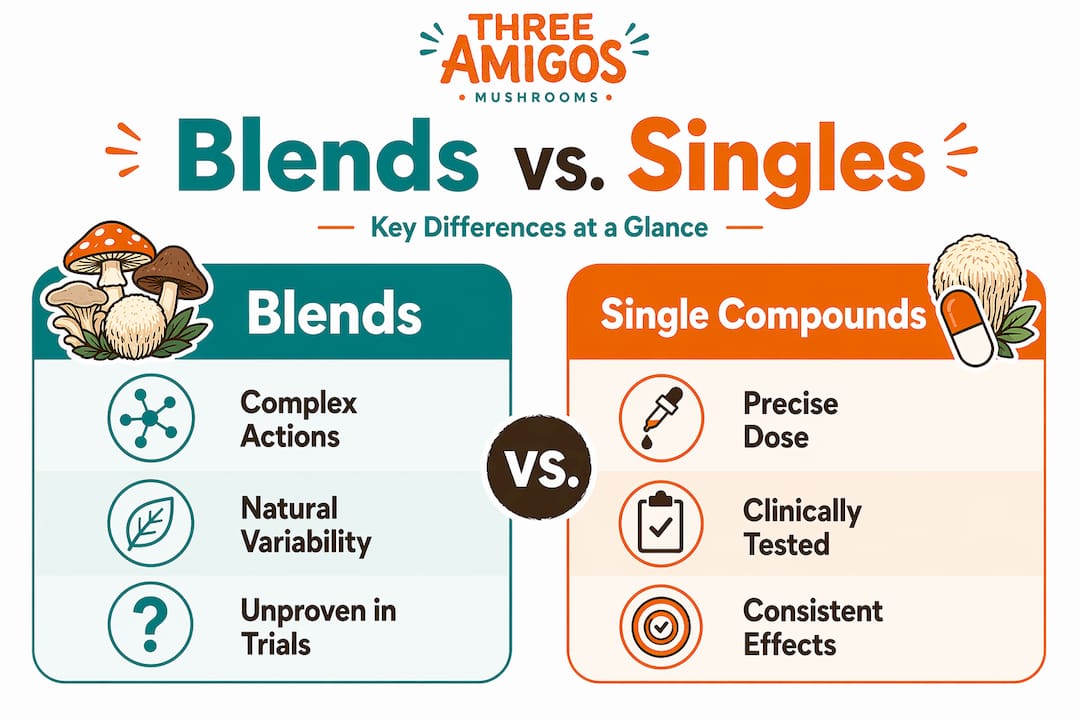
Most clinical trials, including the landmark studies that put psilocybin on the mental health map, use single-compound psilocybin at standardized doses. The comparison table below shows the key practical differences:
| Feature | Whole mushroom blends | Purified single-compound psilocybin |
|---|---|---|
| Receptor targets | Potentially broader | Primarily HTR2A |
| Dosing precision | Variable, harder to standardize | Highly precise and reproducible |
| Clinical trial evidence | Limited direct trials | Extensive growing evidence base |
| Regulatory approval potential | Further from approval | Closer to clinical pathways |
| Real-world accessibility | Available through retailers | Restricted to clinical programs |
| Entourage effect potential | Present (theoretical) | Absent by design |
On the safety front, a systematic review of psychedelics for PTSD found that protocol heterogeneity means conclusions are cautious, but safety is manageable in controlled settings. In other words, the diversity of methods used across studies makes direct comparisons tricky, but the overall safety profile under supervision looks reasonable. Most adverse events in supervised trials are mild and transient, including temporary anxiety, nausea, and emotional intensity that resolves within the session.
“Safety is generally regarded as manageable in controlled settings, though protocol heterogeneity across studies means direct comparisons require caution.” — Systematic review on psychedelics for PTSD, 2025
The clear takeaway from reviewing psilocybin’s brain effects is this: the compound matters, but it is one variable inside a much larger system. Most real-world users are not optimizing receptor binding kinetics. They are seeking relief from depression, creative unlocking, or deeper self-understanding. For those goals, the research increasingly points elsewhere.
Why context, mindset, and protocol matter as much as the blend
This is where the evidence gets surprisingly decisive. Research does not just suggest that set and setting are important. In some analyses, psychological context explains the majority of outcome variability, while compound selection explains comparatively little.
A ResearchSquare preprint found that set and setting explain more variance in outcomes than compound choice in some observational studies. Some analyses attribute as much as 58% of outcome variance to psychological context factors, including expectation, intention, emotional readiness, and physical environment. The blend accounts for a fraction of that.
What does a structured protocol actually look like in practice? Frontiers in Psychiatry describes psychedelic-assisted therapy as using a structured set-and-setting model with three clear phases:
| Phase | What it involves | Why it matters |
|---|---|---|
| Preparation | Goal-setting, medical screening, expectation management | Shapes what the mind brings to the session |
| Administration | Controlled environment, therapeutic support, music, comfort | Directly influences emotional and perceptual experience |
| Integration | Reflection, journaling, therapy sessions post-experience | Converts insight into lasting behavioral change |
The integration phase is perhaps the most underestimated part of any psychedelic practice. An insight without integration fades. A challenging experience without integration can persist as distress. The blend you took matters far less than what you do with the experience afterward.
Before choosing any blend, honest self-reflection is essential. Ask yourself:
- What specific outcome am I working toward, and is it realistic?
- Have I spoken with a health professional about my current medications and mental health history?
- Do I have a trusted support person available before, during, and after the experience?
- Have I researched psychedelic safety protocols relevant to my situation?
- Am I approaching this from a stable emotional baseline, or seeking escape from an acute crisis?
- Is my environment safe, comfortable, and free from interruptions?
These questions do more to protect your experience than any specific blend selection. That is not a dismissal of blend quality. It is a recognition that your internal state and external environment are the primary canvas on which the compound works.
Safety, oversight, and how to access blends legally in Canada
Canada has one of the more progressive frameworks for psychedelic access in the world, but legal and safe access still requires navigating real channels. Understanding the pathway is not bureaucratic pedantry. It is harm reduction in action.
Legal psychedelic-assisted therapy in Canada currently operates under special access programs and approved clinical trials. PSY Qi’s medical program summary outlines that Canadian-access routes for legal and medically supervised therapy emphasize screening and medical oversight, not self-made blends. The pathway typically involves the following steps:
- Initial screening: A medical professional reviews your mental health history, current medications, and cardiovascular health to assess eligibility. Conditions like personal or family history of psychosis are important exclusion factors.
- Formal consultation: You meet with a trained therapist or physician who discusses your goals, explains the process, and establishes expectations before any substance is used.
- Controlled dosing session: The administration happens in a safe, supervised environment. A trained guide or therapist is present throughout the session.
- Post-session integration: Structured follow-up sessions help you process the experience, convert insight into action, and address any difficult material that emerged.
- Ongoing monitoring: Your wellbeing is tracked across multiple sessions and check-ins.
The systematic review for PTSD also found that safety reports in studies may not translate outside protocols, meaning the reassuring safety data we see in research relies heavily on the screening and oversight built into those studies. Remove those safeguards, and the risk profile changes.
Pro Tip: Self-blending at home, even with access to dried mushrooms, introduces unpredictable potency variability. Without lab-verified content, you cannot know what concentration you are taking. Seek products from trusted, quality-controlled sources and, whenever possible, work within a supportive therapeutic framework. You can also find a Canadian therapist through dedicated directories to ensure professional support is part of your process.
A clinical perspective: Blends are not a shortcut—context is the multiplier
Here is the uncomfortable truth that tends to get lost in the excitement around custom formulations and exotic strain combinations: chasing the perfect blend is often a form of magical thinking. The appeal is understandable. If you could just find the right recipe, the work of preparation, reflection, and integration becomes optional. But that is not how this works.
We see this pattern regularly in conversations with people exploring psychedelics for the first time. They spend enormous energy researching strain genetics and compound ratios, and almost no time asking whether they have the emotional readiness, the right environment, or a plan for what they will do with what comes up. Then they are surprised when the experience is confusing or unsatisfying, and they assume they picked the wrong blend.
The evidence does not support that conclusion. Frontiers in Psychiatry is clear that most defensible use cases rely on structured protocols rather than random mixing, with clinical structure mattering more than blend content. The protocol creates the conditions in which any compound, blend or otherwise, can do meaningful work.
That said, blends are not meaningless. The scientific rationale for multi-target effects is legitimate, and for some people with specific therapeutic goals, a well-designed blend under professional guidance may offer an experience that a single compound does not. The important word there is “well-designed,” meaning formulated with known concentrations, tested for quality, and used inside a proper context, not improvised at home.
Think of context as the multiplier. If your context is strong, even a modest dose in a well-chosen blend can yield profound results. If your context is weak, no exotic combination will save the experience. Blends fine-tune; protocol and preparation do the heavy lifting. Understanding how to access the therapeutic benefits of psilocybin starts with accepting this principle.
Exploring blends safely: Trusted resources and next steps
If you have made it this far, you understand that making an informed choice about psychedelic blends requires more than reading strain descriptions. It requires education, preparation, and ideally some form of professional guidance.
At Three Amigos, we have built our resource library and product catalog around exactly this philosophy. Whether you are considering psilocybin microdose capsules for subtle daily support or looking for a deeper introduction through psilocybin science explained, our goal is to give you the knowledge to make choices you can stand behind. For those ready to explore more meaningful doses, our guide to therapeutic uses of dried mushrooms walks through real-world applications with safety and intention at the center. Explore discreetly, prepare thoroughly, and let context do what blends alone never can.
Frequently asked questions
Are psychedelic blends more effective than using a single compound?
Mechanistic research suggests blends may engage more brain targets simultaneously, but human trials rarely demonstrate clear superiority over structured single-compound protocols. The evidence for blends is theoretically promising but not yet confirmed at scale in clinical studies.
Is it safe to make my own psychedelic blend at home?
Self-blending carries real risks from unpredictable potency and unknown interactions. Legal and medical programs emphasize professional screening and oversight rather than DIY preparation, and for good reason. Rely on quality-controlled sources and, wherever possible, professional support.
If mindset and context are so important, does the blend matter at all?
Blends can meaningfully influence the texture and character of an experience, but preparation and environment account for far more outcome variability. Research confirms that mindset accounts for more outcome variance than compound choice in observational studies, making context the foundation on which blend selection becomes relevant.
Can I legally access psychedelic blends for therapy in Canada?
Yes, but the pathway requires medical supervision, eligibility screening, and access through approved channels. Canadian programs are built around oversight and clinical structure rather than self-sourcing, so legal protections and safety measures only apply when you access through recognized routes.
Recommended
- Understanding psychedelic pharmacology for mental health
- Microdosing psychedelics: benefits, risks & safe access
- Why choose psilocybin: benefits and science for wellbeing

Thomas Wrona is a writer, designer, and wellness coach who believes that nature’s wisdom provides an antidote to the stress of modern life. As a former pro athlete, he’s all about staying in motion! When he’s not writing you’ll probably find Thomas outside.