

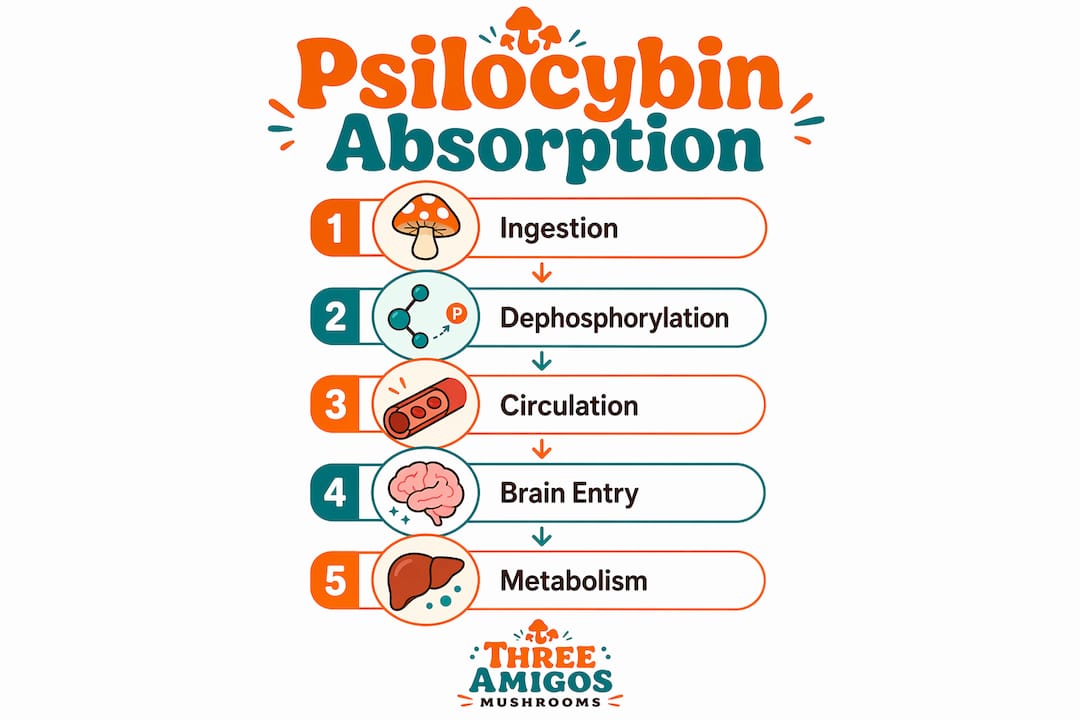
Psilocybin Absorption Explained: How It Works in the Body
TL;DR:
- Psilocybin is rapidly converted to psilocin through enzymatic dephosphorylation in the gut, which determines its psychoactive effects. Its bioavailability averages around 52.7%, with absorption timing and metabolism significantly influenced by individual genetics, physiological state, and formulation. Understanding absorption kinetics is crucial for optimizing therapeutic outcomes and personal experiences with psilocybin.
Psilocybin absorption is the biological process by which ingested psilocybin converts into its active metabolite, psilocin, and enters systemic circulation to produce psychoactive and therapeutic effects. The compound itself is pharmacologically inert. Every effect you experience from magic mushrooms traces back to psilocin, not psilocybin. Understanding psilocybin absorption explained through a pharmacokinetic lens clarifies why onset timing varies, why some people feel effects faster than others, and why formulation choices matter enormously for therapeutic applications. This is the mechanism behind the experience.
How is psilocybin absorbed and converted in the body?
Psilocybin absorption begins the moment the compound reaches your gastrointestinal tract. Alkaline phosphatase enzymes in the gut wall and liver strip the phosphate group from psilocybin in a process called dephosphorylation, producing psilocin. This conversion is nearly complete before systemic circulation, with conversion rates reaching 90 to 97 percent. Measurable psilocybin in blood after oral dosing is essentially zero. What circulates is psilocin.
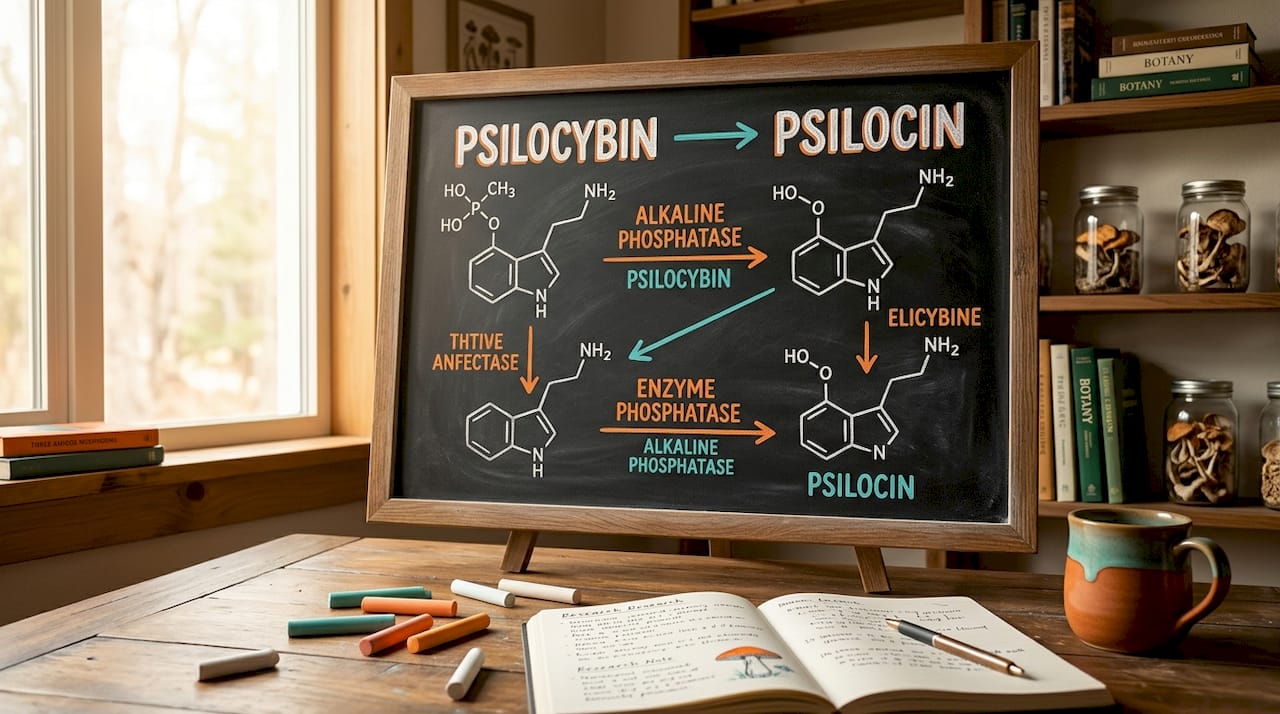
This first-pass metabolism through the gut and liver is the defining feature of oral psilocybin pharmacology. Three enzymatic pathways handle psilocin’s downstream metabolism: CYP2D6, CYP3A4, and glucuronidation. CYP2D6 and CYP3A4 are cytochrome P450 enzymes responsible for oxidative metabolism, while glucuronidation tags psilocin for renal excretion. The efficiency of these pathways varies significantly between individuals, which explains a large portion of the dose-response variability people report.
The sequence matters. Dephosphorylation produces psilocin. Psilocin crosses the blood-brain barrier. Psilocin binds serotonin 5-HT2A receptors. Each step depends on the one before it, meaning any disruption in the enzymatic conversion phase directly affects how much active compound reaches the brain. This is why absorption is not a single step but a timed sequence of drug delivery events that shapes the entire therapeutic impact.
Pro Tip: If you are taking any medication that inhibits CYP2D6 or CYP3A4, such as certain antidepressants or antifungals, your psilocin metabolism may be significantly altered. Always consult a healthcare provider before combining psilocybin with any prescription medication.
What are the pharmacokinetics of psilocin after oral dosing?
Once psilocin enters systemic circulation, its behavior follows a predictable but dose-dependent pattern. Psilocin becomes detectable in blood approximately 30 minutes after ingestion, with peak plasma concentration (Cmax) occurring between 1.8 and 4 hours. This Tmax range explains why some users report effects beginning at 20 to 30 minutes while others wait over an hour. The variability is real and physiologically grounded.
Bioavailability of psilocin after oral psilocybin dosing averages approximately 52.7 percent. That means roughly half of the psilocin produced from dephosphorylation actually reaches systemic circulation. The remainder is metabolized before it can exert central effects. This figure has direct implications for dosing: a 25 mg oral dose does not deliver 25 mg of active compound to the brain.
| Route | Bioavailability | Tmax | Onset |
|---|---|---|---|
| Oral (psilocybin) | ~52.7% | 1.8 to 4 hours | 20 to 60 minutes |
| Intravenous (psilocin) | ~100% | Minutes | Near-immediate |
| Sublingual | Variable, higher than oral | 30 to 90 minutes | 15 to 45 minutes |
Psilocin’s elimination half-life ranges from 1.5 to 4 hours, which aligns with the typical 4 to 6 hour duration of a psilocybin experience. The half-life governs how long active compound remains in circulation, and it scales with dose. Higher doses produce higher Cmax values and slightly extended elimination timelines. This dose-dependent kinetic profile is why therapeutic protocols use precise gram-based dosing rather than rough estimates.
Pro Tip: Tmax is the single most useful pharmacokinetic metric for predicting when effects will peak. If you know your personal Tmax tends toward the longer end of the range, planning your set and setting around a 3 to 4 hour onset window rather than 1 hour prevents unnecessary anxiety during the come-up phase.
What factors affect psilocybin absorption and individual variability?
Psilocybin bioavailability factors span three categories: physiological state, genetic makeup, and formulation. Each introduces measurable variability in how quickly and completely psilocybin converts to psilocin and reaches the brain.
Physiological factors that influence absorption rate:
- Food intake: Eating before dosing delays onset by 30 to 90 minutes and may reduce peak plasma concentration by slowing gastric emptying. Fasting accelerates absorption by allowing faster transit to the small intestine where dephosphorylation is most active.
- Stomach acidity: Lower gastric pH affects enzyme activity and dissolution rate of the mushroom matrix, altering how quickly psilocybin is released for conversion.
- Body composition and metabolic rate: Higher metabolic rates generally accelerate enzymatic processing, producing faster onset and shorter duration.
- Gut microbiome: Emerging research suggests gut bacteria influence alkaline phosphatase activity, though this area remains under active investigation.
Genetic factors that determine metabolism speed:
Polymorphisms in CYP2D6 are particularly significant. Poor metabolizers carry genetic variants that reduce CYP2D6 activity, leading to slower psilocin clearance and potentially prolonged or intensified effects. Ultra-rapid metabolizers, by contrast, clear psilocin faster, which may shorten duration. CYP3A4 variants add another layer of variability. These genetic differences are not rare. CYP2D6 poor metabolizer status affects roughly 7 to 10 percent of people of European descent, making genetic pharmacology a real consideration in therapeutic dosing.
| Factor | Effect on absorption | Clinical implication |
|---|---|---|
| Fasting state | Faster onset, higher Cmax | Shorter wait, more intense peak |
| High-fat meal | Delayed onset by 30 to 90 minutes | Slower, potentially smoother come-up |
| CYP2D6 poor metabolizer | Slower clearance | Prolonged effects, lower dose needed |
| CYP2D6 ultra-rapid metabolizer | Faster clearance | Shorter duration, higher dose may be needed |
Formulation differences represent the most controllable variable. Standard dried mushrooms deliver psilocybin within a fibrous matrix that slows dissolution. Extracted psilocybin in capsule form produces more consistent absorption. Novel psilocin derivatives, such as compound “4e” studied by the American Chemical Society, demonstrate slower, sustained psilocin release with reduced acute hallucinogenic activity. This is the frontier of absorption engineering for therapeutic use.
How does psilocybin absorption connect to its effects and therapeutic potential?
The psychoactive effects of psilocybin are entirely downstream of psilocin’s receptor binding. Psilocin binds primarily at serotonin 5-HT2A receptors concentrated in the prefrontal cortex, with additional activity across cortical and subcortical structures. The strength and timing of this binding directly reflects the plasma concentration-time curve established during absorption.
Key connections between absorption kinetics and clinical outcomes include:
- Receptor occupancy timing: The rate at which psilocin reaches peak plasma concentration determines how abruptly 5-HT2A receptors are engaged. Rapid onset produces more intense, acute psychedelic experiences. Slower, sustained release may produce gentler therapeutic effects with less perceptual disruption.
- Neuroplastic changes: Brain network changes induced by psilocin persist for up to 4 weeks after drug clearance, with clinical improvements in depression and anxiety documented up to 3 months post-session. This means the absorption event triggers biological processes that far outlast the compound’s presence in circulation.
- Dose-response precision: Because Cmax scales with dose, therapeutic protocols at institutions like Johns Hopkins Center for Psychedelic and Consciousness Research and Imperial College London use weight-adjusted or fixed-dose protocols to target specific plasma exposure windows.
“Therapeutic mechanisms of psilocybin are complex and not entirely predictable from receptor distribution alone, requiring integration of absorption kinetics and network effects.” — PMC research on psilocybin brain connectivity
The implication for therapeutic development is significant. Precise control of psilocin plasma profiles and brain penetration timelines is now recognized as the central challenge in optimizing psilocybin therapy. Absorption is not just a delivery mechanism. It is a therapeutic variable. Understanding the psilocybin science behind mental health benefits requires treating pharmacokinetics as inseparable from clinical outcomes.
Key takeaways
Psilocybin’s therapeutic and psychoactive effects depend entirely on psilocin, the active metabolite produced through first-pass enzymatic conversion, with bioavailability, timing, and receptor engagement all shaped by absorption kinetics.
| Point | Details |
|---|---|
| Psilocybin converts to psilocin | Dephosphorylation by alkaline phosphatase converts 90 to 97% of psilocybin before it reaches blood. |
| Bioavailability averages 52.7% | Roughly half of produced psilocin reaches systemic circulation after oral dosing. |
| Tmax ranges 1.8 to 4 hours | Peak plasma concentration timing explains wide variability in reported onset experiences. |
| Genetics alter metabolism speed | CYP2D6 polymorphisms meaningfully change how fast psilocin is cleared and how long effects last. |
| Absorption shapes therapeutic outcomes | Sustained-release formulations can reduce hallucinogenic intensity while preserving neuroplastic benefits. |
Why absorption research is the most underrated part of psilocybin science
Most conversations about psilocybin focus on the experience itself: the visuals, the emotional breakthroughs, the mystical states. Very few focus on the 90 minutes before any of that happens. That gap in attention is a mistake, and I think it is holding back both personal use understanding and clinical development.
What strikes me most about the 2026 research from the American Chemical Society on compound “4e” is not that scientists made a less psychedelic psilocybin analog. It is that they demonstrated absorption timing is a therapeutic dial you can turn. Slower brain penetration, lower peak intensity, same downstream neuroplasticity. That is a profound finding. It means the experience does not have to be overwhelming to be therapeutic. The absorption curve is the therapy.
For individuals using psilocybin for personal development or mental health support, this has practical meaning right now. Fasting before a session is not just a ritual. It is a pharmacokinetic choice that raises your Cmax and shortens your Tmax. Eating a full meal is not just comfort. It is a deliberate decision to smooth the onset curve. These are levers you already have access to.
The challenge I see in the field is that linking molecular kinetics to clinical outcomes remains genuinely hard. Neuroimaging studies show receptor occupancy and network changes, but translating those findings into dosing protocols that reliably produce specific therapeutic outcomes is still years away from standardization. The science is real. The precision is not there yet. Anyone claiming otherwise is overselling the current state of the research.
What I find genuinely exciting is that the pharmacokinetic framework is now solid enough to build on. Tmax, Cmax, half-life, bioavailability: these are no longer theoretical numbers. They are clinical tools. The next decade of psilocybin research will be built on absorption science, and understanding it now puts you well ahead of the conversation.
— Juiced
Explore psilocybin products and education at 3amigos
Understanding how psilocybin is absorbed is the foundation for using it responsibly and effectively. At 3amigos, that foundation extends into the products and resources available to you.
For those interested in controlled, consistent dosing, 3amigos offers microdosing capsules formulated for predictable absorption and minimal variability. Each capsule delivers a measured psilocybin dose, removing the inconsistency of dried mushroom matrix that affects onset timing. For deeper reading on how these mechanisms connect to mental health outcomes, the therapeutic uses guide covers 2026 research on depression, anxiety, and neuroplasticity in plain language. Quality, transparency, and education are the standard at 3amigos.
FAQ
What does psilocybin absorption actually mean?
Psilocybin absorption refers to the conversion of ingested psilocybin into psilocin through enzymatic dephosphorylation, followed by psilocin entering systemic circulation and crossing the blood-brain barrier to produce effects.
How long does it take for psilocybin to absorb and take effect?
Psilocin becomes detectable in blood within 30 minutes of oral ingestion, with peak plasma concentration reached between 1.8 and 4 hours depending on dose, fasting state, and individual metabolism.
Does eating before taking psilocybin affect absorption?
Yes. Food intake delays onset by 30 to 90 minutes by slowing gastric emptying and reducing peak plasma concentration. Fasting accelerates absorption and typically produces a faster, more intense onset.
Why does psilocybin affect people differently?
Genetic polymorphisms in CYP2D6 and CYP3A4 enzymes cause meaningful differences in how quickly psilocin is metabolized and cleared, producing variation in duration, intensity, and onset timing across individuals.
Can formulation change how psilocybin is absorbed?
Yes. Novel psilocin derivatives and engineered formulations can produce slower, sustained release that reduces acute hallucinogenic intensity while maintaining neuroplastic effects, as demonstrated in 2026 American Chemical Society research on compound “4e.”
Recommended
- Psilocybin science explained: unlock mental health benefits
- Psilocybin Interactions Explained: Safe Use and Drug Effects
- Psychedelic neuroscience: Psilocybin’s brain effects explained
- Psilocybin Experience Step by Step: A Complete Guide

Thomas Wrona is a writer, designer, and wellness coach who believes that nature’s wisdom provides an antidote to the stress of modern life. As a former pro athlete, he’s all about staying in motion! When he’s not writing you’ll probably find Thomas outside.