

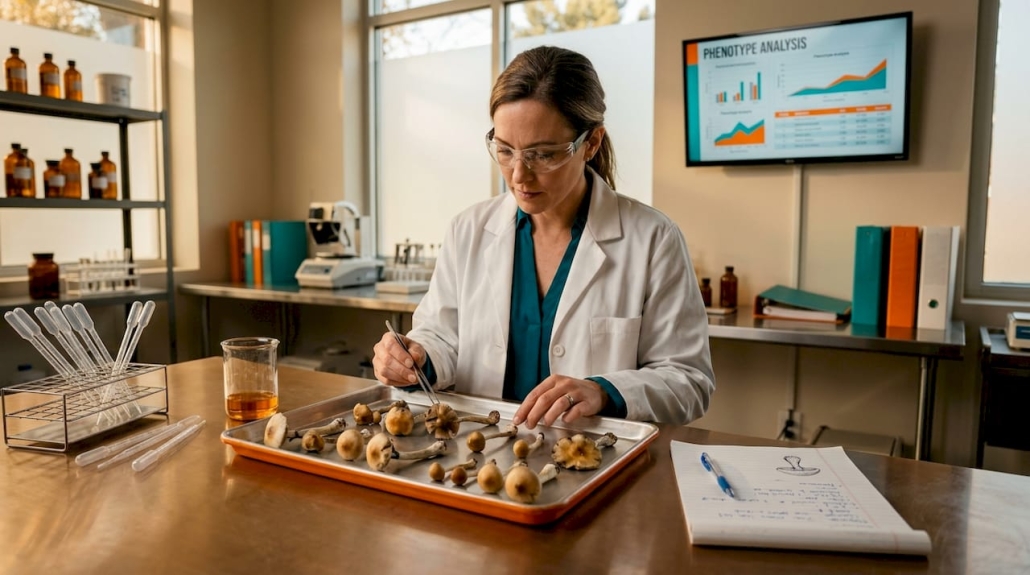
Shroom phenotyping: Guide to potency, traits, and selection
TL;DR:
- Phenotyping enables cultivators and users to identify stable, high-quality mushroom traits for consistent effects and safer therapeutic experiences.
- Advances in AI, chemical analysis, and genetic testing are transforming mushroom assessment methods, making reliable phenotyping more accessible.
Two mushrooms grow side by side in the same substrate, from the same spore batch, under identical conditions. At harvest, one towers with a dense cap and delivers a potent, focused experience. The other sits squat and pale, barely registering on a potency test. Same species. Same grow room. Wildly different results. That gap is not a mystery, it is phenotyping at work. Understanding shroom phenotyping is now one of the most important tools available to Canadian cultivators, consumers, and therapeutic users who want predictable, safe, and effective experiences every single time.
Table of Contents
- What is shroom phenotyping?
- Key traits analyzed in psilocybin mushroom phenotyping
- Modern methods: From manual assessment to AI and genetic testing
- Why phenotyping matters: Consistency, potency, and safety for Canadians
- How to leverage phenotyping: Practical tips for growers and users
- The missing link: Why Canadian mushroom enthusiasts should care about phenotyping now
- Next steps: Exploring science-backed mushrooms with 3 Amigos
- Frequently asked questions
Key Takeaways
| Point | Details |
|---|---|
| Phenotyping explained | Shroom phenotyping is the science of measuring and selecting mushroom traits for quality and predictability. |
| Key traits to track | Critical traits include cap size, color, growth rate, and psilocybin content. |
| Technology advances | AI and advanced testing now allow for faster, more accurate phenotyping. |
| Why it matters | Accurate phenotyping ensures safer, more consistent dosing—key for both personal and therapeutic use. |
| Start small, test smart | Home growers can begin with simple observations but benefit most from lab-verified strains. |
What is shroom phenotyping?
Phenotyping is not a term borrowed loosely from botany. Shroom phenotyping refers to the systematic observation, measurement, and selection of observable physical, morphological, and biochemical traits (phenotypes) in psilocybin mushroom strains. Think of it as building a detailed profile of a mushroom from every observable angle, its size, color, growth pattern, and most critically, its biochemical output.
The goal is straightforward: identify mushrooms that carry traits you want, and propagate them. Whether you are a home cultivator trying to maximize yield, a wellness enthusiast seeking a consistent therapeutic dose, or someone exploring mushroom potency terms for the first time, phenotyping gives you a framework for moving past guesswork.
The core traits assessed in phenotyping cover several categories:
- Morphology: cap shape, size, color, bruising patterns, and stem thickness
- Growth behavior: speed of mycelial colonization, yield per flush, fruiting timing
- Biochemical content: concentrations of psilocybin, psilocin, and baeocystin
- Environmental response: how the mushroom reacts to humidity, temperature, and light changes
- Genetic markers: DNA sequencing to confirm species and strain identity
Phenotyping is the bridge between what a mushroom looks like and what it actually does. Without it, a name on a spore syringe is just marketing.
The practical application is what makes this exciting. When you phenotype with purpose, you stop treating every batch as a coin flip. You build a catalog of reliable, reproducible outcomes.
Key traits analyzed in psilocybin mushroom phenotyping
Once you understand what phenotyping is, the next question is what specifically gets measured and why those measurements matter.
Key phenotypes include fruiting body morphology (cap shape, size, color, stem thickness, gills), growth traits (colonization speed, yield, fruiting patterns), and biochemical profiles (psilocybin, psilocin, baeocystin concentrations). Each category tells a different story about the mushroom’s character.

The factors influencing mushroom potency are more numerous than most people expect. Genetics lay the foundation, but the phenotype is what that foundation actually builds in real conditions.

Here is a breakdown of the main trait categories and why each one matters:
| Trait category | What is measured | Why it matters |
|---|---|---|
| Morphology | Cap size, color, bruising, stem density | Indicates strain identity and maturity at harvest |
| Growth traits | Colonization time, flush yield, primordia density | Predicts productivity and cultivation efficiency |
| Biochemical profile | Psilocybin, psilocin, baeocystin levels | Directly determines potency and effect character |
| Stability | Consistency across multiple flushes | Critical for therapeutic dosing reliability |
| Genetic markers | ITS DNA sequence | Confirms true strain identity beyond appearance |
A fascinating real-world example of integrated phenotyping comes from recent research. In psilocybin contexts, Nammex cultivated 6 Psilocybe species indoors, phenotyped via anatomy, microscopy, DNA sequencing, and HPTLC. That combination of visual, chemical, and genetic tools produced far more reliable characterization than any single method alone.
Why does biochemical profile matter so much? Psilocybin converts to psilocin in the body, and it is psilocin that produces the psychoactive effect. Baeocystin is less studied but may contribute to the overall experience. Strains that test high on all three compounds feel notably different from strains that are heavy on psilocybin alone. For therapeutic applications, this is not a trivial distinction. It affects the depth, duration, and emotional texture of the experience.
Pro Tip: When reviewing strain descriptions, look for data on all three alkaloids, not just psilocybin content. A strain with a balanced baeocystin-to-psilocybin ratio may produce a softer, more nuanced effect that works better for therapeutic settings.
Stability is the trait that does not get enough attention. A strain that produces high potency in flush one but drops significantly in flush three is far less useful than a moderate strain that delivers consistent results across six harvests. For therapeutic use especially, consistency is not a bonus, it is a requirement.
Modern methods: From manual assessment to AI and genetic testing
The methods available for phenotyping have expanded dramatically in recent years, and not all of them require a full laboratory setup.
Methodologies range from manual visual assessment and microscopy for anatomical features to image-based high-throughput phenotyping using RGB/RGB-D cameras, AI and machine vision, chemical analysis, and genetic confirmation. You can think of these as a ladder from low-tech to high-precision.
Here is how the process typically unfolds from basic to advanced:
- Visual observation: Note cap diameter, color, bruising speed (blue coloration indicates psilocin oxidation), stem thickness, and gill structure.
- Yield and growth tracking: Log colonization time, days to first pins, and weight per flush across multiple harvests.
- Microscopy: Examine spore morphology and hyphal structure in detail, useful for distinguishing similar species.
- Chemical analysis (HPTLC or HPLC-MS): Quantify alkaloid content with lab precision. HPTLC (High-Performance Thin-Layer Chromatography) is cost-effective; HPLC-MS (Liquid Chromatography Mass Spectrometry) provides the most accurate results.
- Genetic sequencing (ITS DNA): Confirm species identity at the molecular level, resolve cases where morphology is ambiguous.
The technological acceleration in this space is remarkable. Mushroom phenotyping has transitioned from manual to AI-driven high-throughput systems, reducing processing time from 76 seconds to 2 seconds per sample with 96 to 98% accuracy. That is a 38x speed increase with virtually no loss in precision. In agricultural mushroom farming, this is already transforming operations.
| Method | Time per sample | Accuracy | Equipment cost |
|---|---|---|---|
| Manual visual | 76 seconds | Moderate | Low |
| Microscopy | 10 to 30 minutes | High (anatomy) | Medium |
| HPTLC chemical | Hours | High (chemistry) | High |
| AI image analysis | 2 seconds | 96 to 98% | Medium to high |
| ITS DNA sequencing | Days | Very high | Very high |
For those exploring therapeutic mushroom use, this technology gap matters because it directly affects the quality assurance behind any product you consume or cultivate.
Pro Tip: If you do not have access to a lab, AI-assisted image tools paired with detailed grow logs are still far more useful than relying on strain names alone. Documenting every observable trait across multiple grows gives you a personal phenotyping dataset that improves over time.
Why phenotyping matters: Consistency, potency, and safety for Canadians
This section is where phenotyping stops being an abstract science topic and becomes a practical public health issue for Canadians.
For cultivators and therapeutic users, it is critical to prioritize stable, lab-tested strains because potency varies more by grow conditions and genetics than by name alone, and non-freeze drying better preserves psilocybin content. Strain names are labels. Phenotyping is verification.
The implications for safe use are real and significant:
- A strain sold as “Golden Teacher” from one source may test at 0.6% psilocybin. The same name from another source may test at 1.4%. That is more than double the dose for the same perceived amount.
- Visual similarity between species is notoriously unreliable. Species-specific metabolomics clusters highlight the unreliability of morphology alone for taxonomic identification.
- For microdosing or therapeutic protocols, unpredictable potency can undermine results entirely. A microdose miscalculated by 2x is no longer a microdose.
Consistent phenotyping creates a chain of trust. A cultivator who selects for stable, high-performing phenotypes, tests biochemical content across multiple flushes, and documents genetic identity provides a completely different level of assurance than one who simply grows and ships.
A strain name tells you what someone called the mushroom. Phenotyping tells you what it actually is.
For Canadian users navigating safe mushroom use and exploring the therapeutic benefits available in Canada, this standard of verification is worth seeking out actively. The difference between a reliable experience and an overwhelming one often comes down to whether the source bothered to phenotype.
How to leverage phenotyping: Practical tips for growers and users
Knowing phenotyping exists is useful. Knowing how to apply it is where real improvement happens.
Edible mushroom phenotyping has advanced significantly with AI precision, while psilocybin phenotyping lags due to legal barriers but is accelerating with biotech, with strains like Penis Envy emerging through selective breeding over generations. The legal gap is real, but it is narrowing. Here is how to work within the current reality:
- Document every grow cycle: Record cap diameter, stem length, bruising speed, days to harvest, and dry weight. Build your own database.
- Compare flushes systematically: A strain that maintains consistent weight and appearance across three to four flushes is demonstrating phenotypic stability, which is exactly what therapeutic use requires.
- Select for cloning wisely: When taking tissue cultures or spore prints, select from specimens that consistently match your target traits, not just the biggest or prettiest one from a single flush.
- Seek lab-tested sources: When purchasing dried mushrooms or spore genetics, prioritize suppliers who provide chemical testing data. Guessing potency is avoidable.
- Understand your legal context: In Canada, phenotyping for personal research exists in a legal gray area. Stay informed about current regulations and work within them.
- Consider environmental controls: Humidity, substrate composition, and temperature all affect how a phenotype expresses itself. Document these alongside biological observations to isolate which variables drive the results you see.
The benefits of magic mushrooms for mental health and personal development are real, and understanding phenotyping is one of the most direct ways to access those benefits responsibly.
Pro Tip: When selecting between strains for therapeutic use, prioritize strains with documented stability data over those marketed primarily on potency claims. High consistency at moderate potency outperforms unpredictable high potency every time.
The missing link: Why Canadian mushroom enthusiasts should care about phenotyping now
Here is the honest take: the psychedelic space in Canada has a marketing problem dressed up as a knowledge problem.
Strain names like “Blue Meanie” or “Albino A+” carry enormous cultural weight, but almost none of that weight rests on verified phenotypic data. Most naming conventions in psilocybin mushrooms trace back to single cultivators, subjective reports, and decades of informal selection with no biochemical tracking. That is not science. It is folklore.
We believe the real opportunity for Canadians right now is to demand better standards from producers and themselves. As Canada’s regulatory environment continues to evolve, the gap between “lab-verified mushroom product” and “informally named dried batch” will become legally and ethically significant. The impacts of psilocybin research are accelerating this change faster than most people realize.
AI-driven phenotyping and accessible genetic testing are already mature in the edible mushroom industry. Those tools are coming to the psilocybin space. When they arrive, Canadians who understand phenotyping will already know what to look for and what questions to ask. Those who don’t will keep relying on strain names and guessing.
The broader point is this: consistent, standardized psilocybin is not just a commercial goal. It is a public good. It makes therapeutic protocols more reliable, reduces adverse experiences from dosing errors, and builds the kind of scientific trust that supports long-term policy change. Pushing for phenotyping standards is, in a real sense, part of advocating for psychedelic medicine in Canada.
Next steps: Exploring science-backed mushrooms with 3 Amigos
If phenotyping has shifted how you think about sourcing and selecting mushrooms, the next logical step is finding products that reflect that standard.

At Three Amigos, we take the science seriously. Whether you are browsing magic mushroom edibles made with consistent, quality-verified inputs, reading our psilocybin science guide to deepen your understanding, or exploring therapeutic mushroom uses for structured wellness applications, you will find resources built around education and quality. We believe every Canadian deserves access to products backed by science, not just by reputation. Explore our catalog and educational guides to take your practice from guesswork to grounded.
Frequently asked questions
How is mushroom phenotyping different from genetic testing?
Phenotyping measures observable traits like shape, color, and potency, while genetic testing analyzes DNA sequences to confirm species identity. Morphological ID is less reliable than ITS genetics, and both methods together give the most complete picture.
Why does mushroom potency vary so much, even within one strain?
Psilocybin content varies more by grow conditions and genetics than by strain name, meaning two mushrooms called by the same name can produce significantly different effects depending on how and where they were grown.
Are there any health risks with non-phenotyped psilocybin mushrooms?
Yes. Without verified phenotyping, potency is unpredictable, and therapeutic use requires consistently verified potency for safety. Inconsistent dosing increases the risk of overwhelming or underwhelming experiences, both of which can undermine therapeutic or personal goals.
What methods can home growers use to phenotype mushrooms?
Manual visual assessment and image-based phenotyping are accessible starting points. Track size, color, yield, and bruising across multiple flushes. Full biochemical or genetic analysis requires lab access, but detailed observational records still provide meaningful data over time.
How does freezing affect psilocybin in fresh mushrooms?
Freezing fresh samples converts psilocybin to psilocin, which changes the alkaloid profile and can affect both potency and stability. Drying without freezing is the preferred method for preserving the original chemical composition.
Recommended
- Why mushroom potency varies: factors behind every dose
- Mushroom fruiting conditions: guide to optimal yields
- Psychedelic Mushroom Terms 2026: 0.2-1.3% Potency Guide
- Edible Mushroom Varieties: Culinary, Wellness & Psychedelic Guide

Thomas Wrona is a writer, designer, and wellness coach who believes that nature’s wisdom provides an antidote to the stress of modern life. As a former pro athlete, he’s all about staying in motion! When he’s not writing you’ll probably find Thomas outside.


