

Designing an effective psilocybin research workflow
TL;DR:
- Replicability in psilocybin science faces challenges due to inconsistent workflows and reporting standards, hindering clinical translation. Researchers must rigorously follow a three-phase process—preparation, dosing, and integration—while meticulously documenting each step to ensure reproducibility. Standardized protocols and transparency are essential for advancing equitable, scalable, and scientifically robust psilocybin therapies.
Replicability is the quiet crisis of psilocybin science. Trials produce remarkable clinical signals, yet translating those signals into standardized, scalable mental health treatments keeps stalling because research teams build workflows differently, report them inconsistently, and hand off results that no one else can fully reproduce. A three-phase workflow structure covering preparation, dosing, and integration forms the backbone of every credible psilocybin study, but knowing the framework and executing it rigorously are two very different things. This guide walks researchers and clinicians through each workflow phase in operational detail, covering compliance, environment design, outcome measurement, and reporting standards.
Table of Contents
- Core components of a psilocybin research workflow
- Preparation phase: Ethical, legal, and practical foundations
- Dosing sessions: Protocols, support, and environment design
- Integration phase: Maximizing psychosocial and clinical value
- Standardization, reporting, and troubleshooting: Your workflow checklist
- Why workflow rigor will decide psilocybin’s clinical future
- Explore more psilocybin science and therapeutic resources
- Frequently asked questions
Key Takeaways
| Point | Details |
|---|---|
| Standard workflow phases | Psilocybin research follows a preparation, dosing, and integration sequence for safety and replicability. |
| Rigorous preparation critical | Careful regulatory, ethical, and participant screening is the first step toward a valid workflow. |
| Dosing session structure matters | Environment, therapeutic support, and dosage directly impact outcomes and trial reliability. |
| Integration boosts benefits | Structured integration sessions ensure lasting value, reduce harm, and improve data quality. |
| Standardization enables progress | Clear protocols and transparent reporting make results replicable and move the field forward. |
Core components of a psilocybin research workflow
With the need for repeatability established, let’s break down what an evidence-based psilocybin research workflow actually looks like in practice.
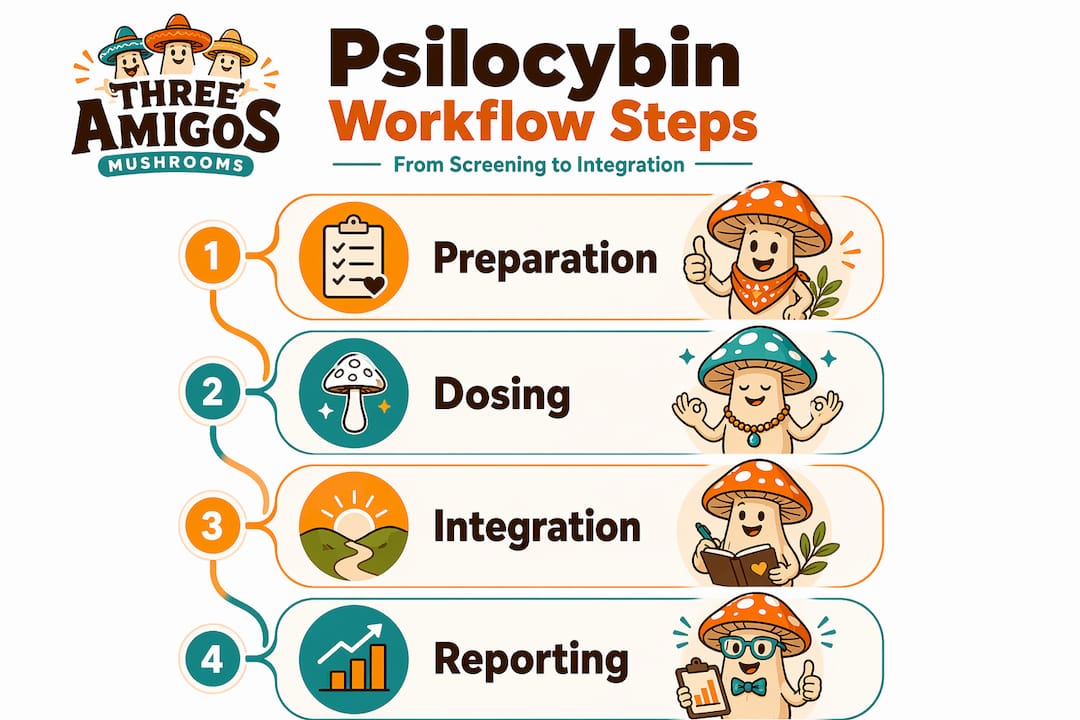
Psilocybin research follows a three-phase structure: preparation, the dosing session, and integration. Each phase has distinct goals, personnel demands, and documentation requirements. Skipping steps or conflating phases is one of the most common sources of variability across trials.
The three-phase psilocybin research workflow:
- Preparation — Participant recruitment, screening, rapport building, psychoeducation, intention setting, and environment orientation.
- Dosing session — Supervised compound administration in a controlled setting with trained therapist pairs, safety monitoring, and non-directive psychological support.
- Integration — Post-session interviews, qualitative and quantitative outcome assessment, adverse event monitoring, and follow-up planning.
| Phase | Primary goal | Key personnel | Core outputs |
|---|---|---|---|
| Preparation | Build safety and informed consent | Therapist pair, study coordinator | Consent forms, screening data, session plan |
| Dosing session | Controlled compound delivery | Therapist pair, safety monitor | Session notes, safety logs, blinding records |
| Integration | Consolidate outcomes, assess safety | Therapist, outcome assessor | Outcome measures, adverse event reports |
Pro Tip: Assign a dedicated documentation lead for each phase. Cross-phase documentation gaps are one of the leading reasons studies fail peer review or regulatory audit. Use standardized templates for every form, note, and checklist from day one.
Each phase generates irreplaceable data. Preparation sessions produce baseline psychological profiles. Dosing sessions produce real-time behavioral observations. Integration sessions produce the primary outcome measures that power your statistical analysis. Missing documentation at any of these points is not just an administrative inconvenience; it directly compromises your study’s reproducibility and publication potential.
Preparation phase: Ethical, legal, and practical foundations
Before enrolling a single participant, robust preparation is essential. Here’s how to set a compliant, ethical foundation that will hold up to scrutiny throughout the entire study.
Setting up psilocybin trials involves navigating significant legal and ethical challenges, including licensing requirements, rigorous participant screening, and standardized therapist training. Skipping any of these steps creates liability, not just scientific weakness.
Regulatory and licensing requirements:
- Secure Schedule I research authorization from the relevant national or provincial authority before any procurement or administration.
- Maintain a current Investigational New Drug (IND) or equivalent authorization file, including compound sourcing documentation.
- Verify that your institution’s pharmacy or controlled substance storage meets all applicable security standards.
- Keep licensing renewal timelines on your master project calendar; lapses can pause trials mid-enrollment.
Ethics board review and informed consent:
The informed consent process in psilocybin research carries additional nuance compared to standard pharmacological trials. Participants must understand the subjective nature of the experience, the possibility of emotionally difficult content arising during the session, and the limits of therapist intervention. Ethics boards are increasingly asking researchers to document how they address ethical frameworks for psilocybin research around participant autonomy, particularly in vulnerable populations.
“Setting up studies involves navigating legal, ethical, and safety challenges: regulatory licensing, rigorous screening protocols, and standardized training for therapists are all non-negotiable prerequisites.” (arXiv, 2025)
Participant screening criteria:
Screening must exclude candidates with a personal or first-degree family history of psychosis or bipolar I disorder, current or recent use of serotonergic medications, significant cardiac risk factors, and clinically significant cognitive impairment. Cardiovascular screening is often underreported but essential, since psilocybin produces transient increases in blood pressure and heart rate.
Therapist training and fidelity monitoring:
Therapist training should cover the specific therapeutic model used in your trial, whether that is a supportive or directive model, and training must be documented with session fidelity monitoring. Inter-rater reliability checks on therapist behavior, conducted by an independent reviewer using recorded sessions, protect both participant welfare and data quality.
Pro Tip: Build a therapist fidelity log that mirrors your consent and screening logs. If your publication gets audited for reproducibility, reviewers will specifically look for documented training standards and whether session fidelity was assessed throughout the trial.
Dosing sessions: Protocols, support, and environment design
Once legal and ethical groundwork is set, it’s time to focus on the engine of psilocybin research: the dosing session itself.

Dosing sessions typically last 6 to 8 hours in a carefully controlled environment equipped with eye shades, curated music playlists, and a trained therapist pair providing non-directive support. Every environmental and procedural detail you choose will affect participant experience and therefore your data.
Step-by-step dosing session sequence:
- Arrival and orientation — Participant arrives 30 to 60 minutes early; therapists confirm psychological readiness, review safety protocols, and address any last-minute concerns.
- Baseline safety checks — Vital signs recorded, any medication conflicts verified, and brief mood state measure administered.
- Compound administration — Psilocybin (typically 25 mg therapeutic dose) or placebo (1 to 5 mg or niacin) administered orally, with time of administration logged precisely.
- Onset support — Participant reclines with eye shades; music playlist begins; therapists remain present and available but non-intrusive.
- Active session support — Therapist pair provides grounding if participant becomes distressed, using a “trust the process” approach unless safety is at risk.
- Post-peak debrief — As effects subside, therapists engage in brief reflective conversation; participant begins early integration journaling.
- Discharge and safety assessment — Vital signs rechecked; a companion escorts participant home; no driving permitted.
| Feature | Therapeutic dose | Placebo/low dose |
|---|---|---|
| Compound | Psilocybin 25 mg | Niacin or 1 to 5 mg psilocybin |
| Session duration | 6 to 8 hours | 6 to 8 hours (matched) |
| Therapist support | Pair, non-directive | Pair, same protocol |
| Eye shades and music | Yes | Yes |
| Blinding success | Partial (effects detectable) | Partial |
A significant blinding challenge in psilocybin trials: both participants and therapists can often identify the active condition because the subjective effects of 25 mg psilocybin are unmistakable. This known limitation should be explicitly addressed in your methods section and in any outcomes interpretation. Using active placebos like niacin improves blinding somewhat, but researchers should report blinding assessment data directly.
Statistic to note: Most current trials administer two dosing sessions spaced 2 to 6 weeks apart, a protocol that has emerged from dosing session research as optimal for balancing effect size with safety monitoring.
Pro Tip: Record room temperature, ambient light levels, and music playlist version for every session. These details are rarely reported but directly influence subjective experience. Under ReSPCT reporting standards, you will need this data anyway, so build it into your session log template now.
Integration phase: Maximizing psychosocial and clinical value
After dosing, the participant’s journey continues. Integration sessions anchor any benefits and capture the outcome data that will define your study’s scientific contribution.
Integration is the phase where psilocybin’s clinical promise either crystallizes into measurable, lasting benefit or dissipates into anecdote. Processing experiences to consolidate benefits is not a soft add-on; it is the mechanism by which neuroplasticity driven insights become behavioral and psychological change.
Core integration session goals:
- Review the participant’s experience narrative with trained therapists, identifying meaning-making opportunities and unresolved distress.
- Administer validated outcome measures at pre-specified time points, commonly one week, one month, and three months post-dosing.
- Screen for adverse effects including prolonged anxiety, headspace difficulties, or relationship disruptions that may signal challenging integration.
- Collaboratively set behavioral goals that translate session insights into daily life changes.
- Document therapist observations in structured notes that can feed into both qualitative and quantitative analysis.
Outcome measurement best practices:
Quantitative measures commonly used in psilocybin trials include the Quick Inventory of Depressive Symptomatology (QIDS), the Beck Depression Inventory (BDI), the Mystical Experience Questionnaire (MEQ), and measures of psychological flexibility. Qualitative methods, including participant narrative interviews and thematic analysis, capture dimensions that standardized scales miss entirely.
For psilocybin therapy integration, the timing and quality of integration sessions predict long-term outcomes more reliably than the dosing session experience alone. Researchers who treat integration as a box-checking exercise consistently report weaker effect sizes than those who treat it as a primary intervention.
Pro Tip: Use a mixed methods design that pairs every quantitative outcome measure with a brief structured qualitative interview. The qualitative data will help you interpret anomalous quantitative results and will significantly strengthen your discussion section when reviewers push back on mechanism.
Standardization, reporting, and troubleshooting: Your workflow checklist
With a completed workflow, ensuring standardization and transparency is crucial for scientific progress and publication potential.
ReSPCT guidelines recommend reporting across 30 items organized into four domains: physical environment (location, lighting, decorations), dosing procedure (music, interventions used), therapeutic framework (preparation and integration sessions, personnel qualifications), and subjective experiences (trust, safety, set and setting quality). These standards exist because the field recognized that session context is itself an active ingredient.
Common reporting pitfalls and how to fix them:
- Poor documentation of environment — Log physical setup details before every session using a standardized checklist. Include room dimensions, light levels, furniture layout, and music playlist version.
- Variable therapist training — Require therapists to complete a documented training program with pre-trial competency assessment. Record and review at least 20% of sessions for fidelity.
- Omitted integration session details — Pre-specify integration session frequency, duration, and structure in your protocol. Report deviations transparently.
- Inadequate placebo reporting — Always include blinding assessment data. Report how many participants correctly guessed their condition.
- Missing adverse event tracking — Use a prospective adverse event log from session day onward, not retrospective self-report.
Less than half of trials currently report standardization measures such as manualized procedures, therapist training standards, and fidelity monitoring. This is not a minor oversight; it is the primary reason the field struggles to pool data across sites or replicate findings consistently.
| Reporting domain | ReSPCT items | Common gap |
|---|---|---|
| Physical environment | Location, lighting, decor | Often omitted entirely |
| Dosing procedure | Music, therapist interventions | Playlist version rarely reported |
| Therapeutic framework | Prep/integration structure, personnel quals | Integration sessions under-detailed |
| Subjective experience | Trust, safety, set and setting | Rarely quantified |
“Variability in psilocybin effect variability across diagnoses, therapy intensity, and session adaptations means that undocumented workflow decisions actively impede mechanistic understanding and clinical translation.” (PubMed, 2025)
Troubleshooting checklist:
- Run a pre-trial documentation audit against ReSPCT items before your first participant.
- Assign a study monitor to review compliance logs weekly.
- Hold a mid-trial standardization review at the halfway enrollment point.
- Conduct a post-trial reporting check before manuscript submission.
Why workflow rigor will decide psilocybin’s clinical future
Here is the uncomfortable reality: the biggest obstacle to psilocybin reaching patients is not regulatory resistance or public skepticism. It is the quality of the documentation sitting in researchers’ shared drives right now.
Standardization gaps undermine replicability and block both mechanistic understanding and clinical translation. When meta-analyses try to pool data from multiple psilocybin trials, they often find that the apparent effect heterogeneity is not about the compound at all. It is about unreported differences in therapist training, room setup, music choices, and integration session depth. The active ingredient is not just psilocybin. It is the entire context in which psilocybin is delivered.
Workflow rigor also has a direct equity implication. Current protocols are intensive, requiring highly trained therapist pairs, multiple preparation sessions, full-day dosing appointments, and weeks of integration support. This model is not scalable to public mental health systems without documented, transferable protocols. If the field cannot produce manuals that train competent therapists at scale, psilocybin-assisted therapy will remain exclusive to research centers and private clinics. That outcome would be a failure of the science, not a feature of the compound.
There is also a workforce argument. Every hour a research team spends reconstructing undocumented workflow decisions is an hour not spent on the next trial. Transparent, detailed psychedelic therapy best practices shared across teams accelerate the entire field. The labs producing the most reproducible results are not necessarily running the most innovative trials. They are the ones who built airtight documentation habits from day one.
Ultimately, what you choose to report, or not report, shapes not just your publication record but the real-world outcomes of the patients this research is meant to serve.
Explore more psilocybin science and therapeutic resources
Your workflow is only as strong as the knowledge base behind it. Whether you are refining a trial protocol, building a training program for your therapy team, or seeking to connect with other practitioners in the field, having access to the right resources accelerates everything.
Three Amigos offers an expanding library of psilocybin science and mental health content developed specifically for researchers, clinicians, and informed practitioners. For a step-by-step breakdown of session protocols aligned with current trial standards, the psilocybin session workflow guide covers administration sequences, environment design, and therapist role distinctions in practical detail. If you are looking to build or expand a therapeutic team, use the psychedelic therapist directory to find qualified Canadian practitioners who work within evidence-based frameworks. Quality research starts with quality support.
Frequently asked questions
What is the typical duration of a psilocybin dosing session?
Psilocybin dosing sessions usually last 6 to 8 hours in a low-distraction, therapist-supported environment with eye shades and a curated music playlist.
Which doses are commonly used in psilocybin therapy trials?
Most trials use 25 mg as a therapeutic dose and 1 to 5 mg psilocybin or nicotinamide as a low-dose placebo, typically across two sessions spaced 2 to 6 weeks apart.
What are the critical elements for reporting a psilocybin research study?
ReSPCT guidelines require reporting on 30 items covering physical environment, dosing procedures, therapeutic framework, and participant subjective experiences to allow full reproducibility.
Why is standardization important in psilocybin research workflows?
Standardization supports replicability, mechanism discovery, and safe clinical translation by making it possible for other teams to reproduce your conditions and compare results across sites.
How are participant safety and suitability ensured?
Screening excludes participants with medication conflicts, psychosis or bipolar history, significant cardiac risk, or cognitive impairment, combined with rigorous ethics-board-approved informed consent procedures.
Recommended
- Psilocybin Safety Workflow: Step-by-Step Guide for Canada
- Safe mushroom consumption workflow for mental health 2026
- Psilocybin Experience Step by Step: A Complete Guide
- How to Dose Psilocybin Safely for Best Results

Thomas Wrona is a writer, designer, and wellness coach who believes that nature’s wisdom provides an antidote to the stress of modern life. As a former pro athlete, he’s all about staying in motion! When he’s not writing you’ll probably find Thomas outside.